
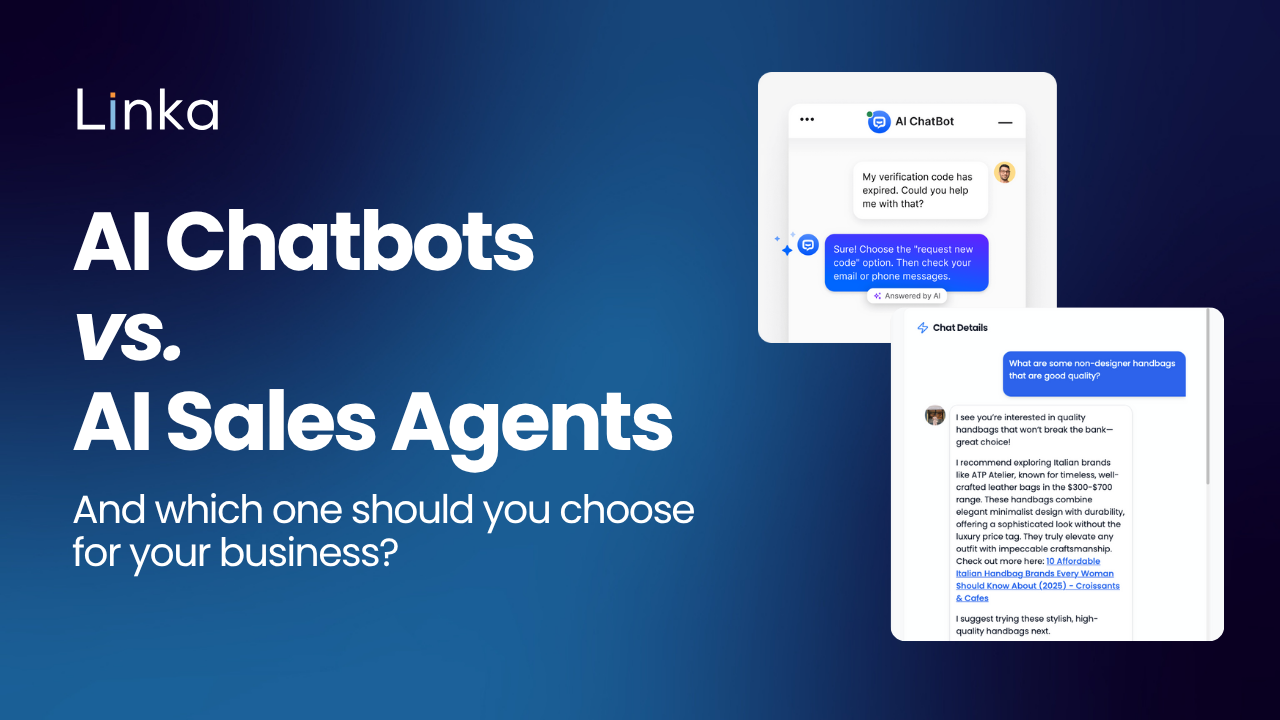
It's no secret that AI is revolutionizing the way enterprises interact with their customers. However, it's also important to note that not all AI tools are created equal. While typical chatbots have become a staple for customer support, there is a new player emerging that’s about to change the game entirely: AI sales agents.
What you should know is that these advanced agents do more than just answer questions. They drive revenue, engage customers on a deeper level, and transform passive interactions into active sales opportunities. For enterprises looking to scale and thrive in a competitive market, understanding the difference between these two technologies is no longer optional, it’s essential.
The recent explosion of artificial intelligence in business has brought a wave of new tools, but it's also created a lot of confusion. Two terms that often get mixed up are "AI chatbots" and "AI sales agents." On the surface, they may seem similar as both live on your website and interact with visitors. But underneath that, they are fundamentally different machines built for entirely different purposes.
Traditionally, businesses have used chatbots to handle basic questions and cut down on support tickets. Yes, it was a step forward, but it was a defensive move and a way to manage costs. What if your AI could do more than just answer questions? What if it could actively drive revenue, and turn every visitor interaction into a sales opportunity? That's not a chatbot's job. That's the work of an AI sales agent.
In this article, we'll break down the critical distinctions between these two technologies. We'll explore why one is built for support, and the other is designed for sales. For any e-commerce brand, enterprise, or consultant looking to thrive in the digital AI space, understanding this difference is key to unlocking a new level of automated growth.
Let’s start with what we know. AI chatbots are the digital equivalent of a friendly receptionist or a helpful librarian. Their primary job is to provide information and support. They are programmed to answer frequently asked questions, guide users to relevant pages, and handle simple, repetitive tasks. Think about the last time you asked a bot for a company's return policy or to track an order. That’s a classic chatbot interaction.
These tools are built on rule-based systems or basic natural language processing (NLP). This means they follow a pre-defined script and recognize specific keywords. If a user's query fits into one of its pre-programmed conversational flows, the chatbot can provide a quick, accurate answer. This makes them incredibly useful for customer service departments looking to improve efficiency.

The main goal of chatbots for enterprise is to reduce support tickets and the workload on human agents. By automating answers to common questions, they free up support teams to focus on more complex, high-touch issues, which is a cost-saving measure. By handling a high volume of simple inquiries 24/7, chatbots help businesses scale their support operations without having to increase headcount.
Common use cases for enterprise chatbots include:
While chatbots are great at what they do, their limitations become obvious when conversations move beyond the script. Their intelligence is confined to the specific rules and data they were trained on. For example:
Essentially, a chatbot is a problem-solver, not a revenue-generator. It's designed to answer questions, not to create desire or close a sale. This is the fundamental ceiling that led to the evolution of a more powerful, sales-focused tool: the AI sales agent.
If a chatbot is the front-desk receptionist, think of an AI sales agent as your top-performing salesperson. It's the one who knows every product inside and out, understands customer psychology, and never misses an opportunity to make a sale.
The primary goal of AI sales agents is as follows: to generate revenue. They go far beyond scripted answers. Built on advanced Large Language Models (LLMs), they go far beyond scripted answers. They are trained on your entire ecosystem of content including your blog posts, product pages, FAQs, reviews, videos, affiliate links + more. Now, they don't just answer questions; they have consultative, intelligent conversations that guide users toward a purchase.
Imagine an AI that can "clone your mind," capturing your expertise, recommendations, and sales acumen to serve thousands of customers at once. That's the power of an AI Sales Agent.
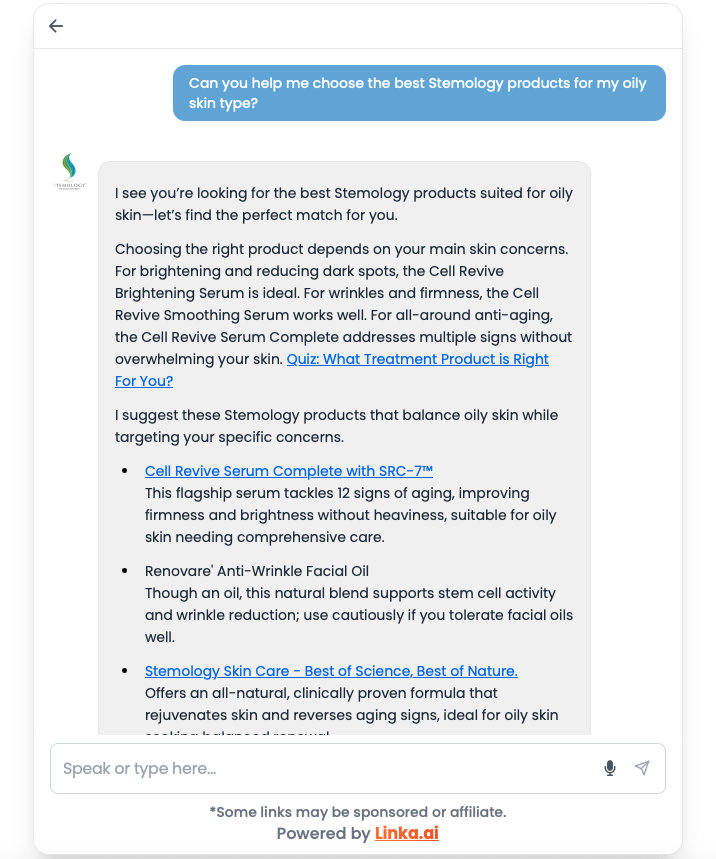
Unlike chatbots that focus on saving costs, AI sales agents are built to make money. They turn your website from a static library of content into an interactive, monetized experience. They proactively engage visitors, understand their needs, and deliver personalized recommendations that lead directly to a sale or an affiliate click.
Examples of AI sales agents in action:
These are all prime examples of how AI sales agents are turning content into revenue.
So what exactly is it that gives AI Sales Agnts their selling superpower? It's their advanced technology. For example, AI Sales Agents possess:
An AI Sales Agent isn't just a conversational tool. It's a sales-focused AI layer for your entire digital presence. It’s designed to automate sales, not just support.
To fully grasp the distinction between AI Chatbts and AI Sales Agents, let's put them side-by-side. While both use "AI" to communicate, their purpose, capabilities, and business impact serve completely different purposes.
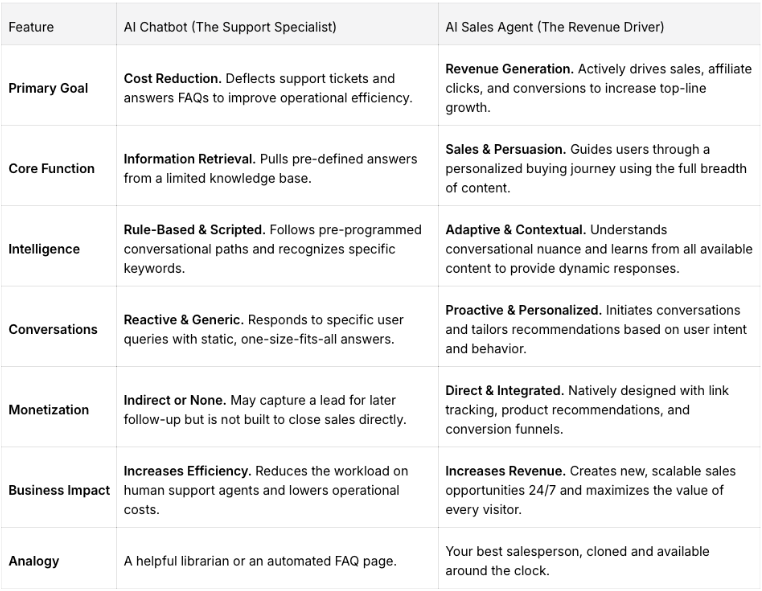
The choice between chatbots for enterprise and AI sales agents comes down to a simple question: Are you playing defense or offense? Chatbots help you manage your existing workload. AI sales agents help you actively grow your business. They don’t just answer questions, they create customers.
For businesses looking to leverage AI for growth, the conversation must shift from "How can we answer more questions?" to "How can we sell more effectively?" That shift is the leap from a chatbot to an AI sales agent.
The initial wave of enterprise AI was about optimization and efficiency. Companies adopted chatbots for enterprise to streamline workflows and cut operational costs. It was a logical first step. But the next frontier of AI is not about saving money. It's about making money.
Businesses are quickly realizing that the true ROI of AI lies in its ability to drive top-line growth. A chatbot that saves a few hours for a support team is valuable. But an AI sales agent that generates thousands of dollars in new revenue every month is transformative.
The market is hungry for solutions that directly impact the bottom line. Large enterprises, e-commerce brands, and affiliate marketers alike are looking for ways to monetize their digital assets more effectively.
Brands & marketers are already seeing incredible results. Oliver Pet Care uses its agent to provide expert pet advice and link to store products, turning customer queries into sales. Beach Now uses their agent to guide visitors on the best chair & umbrella rental packages, clarifying which ones are the best choices based on their needs. Croissants and Cafes uses her agent as a 24/7 stylist, monetizing her fashion content around the clock. These are not just fun experiments; they are powerful AI sales agents delivering measurable ROI.
The trend is clear: while chatbots for enterprise will continue to play a role in customer support, the strategic focus is shifting to revenue-generating AI. Businesses want tools that don’t just talk to customers but convert them.
So, do you need a chatbot, an AI sales agent, or both? The answer depends entirely on your business goals.
Ask yourself this fundamental question: What is the primary job I need this AI to do?
It’s not necessarily an either/or choice. A large enterprise might use a chatbot for its support section and an AI sales agent on its product and blog pages. However, for most e-commerce brands, consultants, and website owners/bloggers whose primary goal is monetization, the choice is clear. A chatbot is a helpful accessory; an AI sales agent is a core part of the sales engine.
When making your choice, consider the platform. Many chatbot builders are general-purpose tools. They weren't designed with monetization in mind. In contrast, solutions like Linka.ai are purpose-built for sales. They are verticalized solutions with link tracking, conversion analytics, and content-driven training at their core. This specialization makes them far more effective at the job of generating revenue.
The difference between AI chatbots and AI sales agents is the diference between cost vs revenue, support vs sales, and passive information vs active monetization. Chatbots were the first-adoption drivers, introducing businesses to the power of conversational AI. But in today's world, growth is the mandate.
AI sales agents represent the future. They are proactive, intelligent, and relentlessly focused on the one metric that matters most: revenue. They empower you to clone your expertise, put your sales on autopilot, and turn your hard-earned content into a 24/7 monetization machine.
If you’re ready to move beyond simply answering questions and start driving real, measurable growth, it’s time to look beyond chatbots. It’s time to embrace the power of an AI sales agent.
Ready to build your own revenue-driving AI?
Linka.ai is the platform designed for brands and experts who want to scale their sales, and monetize. In just minutes, you can build a no-code custom AI sales agent, trained on your content and ready to convert your audience.