

.webp)
.webp)
Connect your content instantly
Capture leads, sell services, products & affiliate offers 24//7
There has never been more AI software competing for your attention — and never more confusion about which tools actually move the needle on sales versus which ones just add another subscription to your monthly expenses.
This guide cuts through it. We're not covering AI tools for accounting, design, or writing. We're focused specifically on the tools that help you make money with AI — capturing leads, converting visitors, automating sales conversations, and turning your existing content and audience into revenue.
Whether you're an eCommerce brand trying to convert more of your traffic, a creator with 50,000 Instagram followers, or a coach selling a high-ticket programme, there's a tool on this list that applies to your situation.
We've organised these by category — because the best AI sales tool for a solopreneur is very different from the best one for a DTC brand. Start with the category that matches your biggest sales bottleneck.
Before the list, it's worth being clear on what separates a genuinely useful AI sales tool from one that just sounds good in a product demo.
The best AI tools for sales share four characteristics:
They're measurable. If you can't see what's converting and what isn't, you can't improve. Every tool worth using gives you data on what's working.
With that framework in mind, here are the best AI tools for sales in 2026, organised by the job they do. For a deeper look at how these tools fit into an overall sales strategy, see our guide to scaling your sales with AI.
An AI sales agent is the most powerful category of sales tool available in 2026.
Unlike simple chatbots that follow a script, an AI sales agent is trained on your specific content, products, and brand voice — and it can have intelligent, personalised conversations that guide people toward a purchase.
It works 24/7, across your website, social channels, and DMs, without you being involved in every conversation.
Best for: Creators, coaches, consultants, eCommerce brands, and anyone selling online who wants to convert more traffic without adding headcount.
What it does: Linka trains a custom AI agent on your content — blog posts, product pages, FAQs, Instagram reels, newsletters, and more. The agent then deploys across your website, link-in-bio, and Instagram DMs, answering questions, qualifying leads, recommending products, and processing payments — automatically, 24/7.
Linka angle: This is the core recommendation for anyone whose primary sales bottleneck is response time, lead qualification, or converting DM and website traffic. Unlike generic chatbot builders, Linka is purpose-built for monetisation — with built-in affiliate tracking, payment processing, CRM integration, and analytics.
What sets Linka apart from other AI chat tools is the depth of its training. Most chatbot platforms are built around scripted flows — you define the conversation tree, and the bot follows it. Linka's agents actually understand your content and respond to open-ended questions the way a knowledgeable team member would. See how Linka's features work and view pricing plans.
Best for: eCommerce brands and small businesses that want a straightforward chatbot for customer support and basic lead capture.
What it does: Tidio combines live chat with AI-powered chatbots that handle FAQs, qualify leads, and escalate to a human when needed. It integrates well with Shopify and other eCommerce platforms.
Linka angle: Tidio is a solid support tool, but it's built around reactive customer service rather than proactive sales. It won't proactively engage visitors, recommend products based on a conversation, or deploy across Instagram DMs. For businesses whose primary goal is revenue — not ticket deflection — Linka is the more appropriate choice.
Best for: Mid-market and enterprise B2B companies with dedicated sales teams and high inbound traffic.
What it does: Drift uses AI to engage website visitors in real time, qualify leads, and route them to the right sales rep. It's deeply integrated with CRM systems like Salesforce and HubSpot.
Linka angle: Drift is enterprise-grade and priced accordingly. It's designed for B2B sales teams, not individual creators or small business owners. If you're a solopreneur or small team looking to automate your sales, Linka gives you the same core capability (conversational lead capture and qualification) at a fraction of the cost and complexity.
Instagram DMs are one of the highest-intent sales channels for businesses with an active social presence. When someone messages you asking about a product or service, they're on the edge of a decision.
The tools in this category help you capitalise on that intent automatically. For a full breakdown of how to set this up, see our guide to auto DM on Instagram to drive sales.
Best for: Creators, influencers, and businesses who get significant inbound interest through Instagram comments and DMs.
What it does: Linka's AI agent can be deployed directly into your Instagram DMs. When followers comment on your posts or message you directly, the agent responds instantly with personalised answers, product recommendations, and affiliate links — no manual effort required.
Linka angle: Unlike ManyChat, which works primarily on keyword triggers and pre-built flows, Linka's Instagram agent understands open-ended questions and responds with context. A follower asking 'which product is right for my skin type?' gets a real answer, not a menu of options.
Best for: Creators and businesses who want to automate comment replies and DM flows using keyword triggers.
What it does: ManyChat lets you set up automated DM flows triggered by specific keywords in comments or direct messages. When someone comments 'link' on your post, they automatically receive a pre-written DM with the relevant link.
Linka angle: ManyChat is excellent for simple keyword-trigger automation and has a large user base among creators. Its limitation is that it's flow-based — it can't handle open-ended questions or personalise beyond what you've pre-programmed. For businesses that want genuine conversational sales in their DMs, an AI-powered agent like Linka handles the complexity that ManyChat can't.
Lead generation is the top of every sales funnel: getting the right people into your world and capturing enough information to follow up.
These tools help you do that faster and at greater scale. Once you have leads, you'll need a system to qualify and convert them — which is where an AI sales agent becomes essential.
Best for: Any business that wants to capture leads from website traffic, Instagram, or newsletter audiences without manual follow-up.
What it does: Linka's AI agent captures lead details — name, email, and conversation context — automatically during every chat interaction. These leads sync to your CRM via Zapier or can be managed directly in Linka's built-in contact manager.
Linka angle: What makes Linka's lead capture different is that it qualifies while it captures. By the time a lead hits your CRM, the agent has already asked the right questions, so you know their budget, timeline, and specific need before you ever reach out.
Best for: B2B businesses and sales teams doing outbound prospecting — finding and contacting potential customers who haven't heard of you yet.
What it does: Apollo.io gives you access to a database of over 275 million contacts, with AI-assisted outreach sequencing, email personalisation, and CRM integration. It's one of the leading tools for outbound B2B sales prospecting.
Linka angle: Apollo is built for outbound sales, allowing you to find people who don't know you yet. Linka is built for inbound sales — converting people who already found you. For businesses with an existing audience or inbound traffic, Linka is the higher-leverage play. For those who need to actively build a pipeline from scratch, Apollo fills a different gap.
Best for: Small to mid-sized businesses that want an all-in-one CRM with AI-powered email, lead scoring, and pipeline management.
What it does: HubSpot's AI features include lead scoring, email personalisation, meeting scheduling, and sales pipeline forecasting. The free CRM tier is genuinely useful, and the paid tiers add increasingly sophisticated automation.
Linka angle: HubSpot is excellent at managing leads once you have them. It's less effective at generating or qualifying them in the first place. Many Linka users connect Linka to HubSpot via Zapier — Linka handles the initial conversation and qualification, and HubSpot manages the follow-up and pipeline from there.
For creators, bloggers, and content-led businesses, the sales channel is the content itself. The tools in this category help you turn your existing content library into an active revenue stream, rather than a passive archive that people read and leave.
This is the essence of building your own AI sales engine.
Best for: Bloggers, publishers, newsletter writers, and creators who have built a content library and want to monetise it more effectively.
What it does: Linka scans your entire content library — blog posts, newsletters, Instagram reels, YouTube transcripts, PDFs — and trains an agent that can answer audience questions by drawing on that content. When a reader asks a question, the agent responds with a personalised recommendation and the relevant affiliate link or product.
Linka angle: This is one of Linka's most powerful and under-appreciated use cases. That blog post you wrote two years ago that still gets 500 visitors a month? With Linka deployed on that page, every visitor can ask questions and get personalised product recommendations — turning a passive archive into an active sales tool.
Best for: Anyone who wants to connect their sales tools and automate the handoffs between them without writing code.
What it does: Zapier connects 7,000+ apps and now includes AI-powered 'Zaps' that can make decisions, summarise data, and route information intelligently between tools. It's the connective tissue between your sales stack.
Linka angle: Linka integrates with Zapier natively, which means leads captured by your Linka agent can automatically flow into HubSpot, Mailchimp, Google Sheets, Slack, or any other tool you use. This is how you build a fully automated sales pipeline without custom development.
Getting a lead's attention is only half the battle. The follow-up is where most sales are won or lost... and it's also where most businesses are slowest.
These AI tools help you follow up faster, more consistently, and more personally than you could manage manually. This ties directly into the broader principle of automating your affiliate and sales strategy to earn more while doing less.
Best for: eCommerce brands that sell products online and want AI-powered email sequences for cart abandonment, post-purchase, and re-engagement.
What it does: Klaviyo uses AI to predict the best send times, segment audiences, personalise email content, and identify customers at risk of churning. Its AI product recommendation engine pulls from purchase and browse history to surface the right products for each customer.
Linka angle: Klaviyo is excellent for post-purchase email automation and eCommerce retention. It's complementary to Linka, not a replacement — Linka handles the real-time, on-site and DM conversations that happen before someone buys; Klaviyo handles the email relationship after.
Best for: B2B businesses and agencies doing high-volume cold email outreach to generate new leads.
What it does: Instantly.ai helps businesses send personalised cold email sequences at scale, with AI writing assistance, inbox warm-up, and deliverability management. It's designed to get past spam filters and into primary inboxes.
Linka angle: Instantly is built for outbound cold email, reaching people who haven't heard of you. Linka is built for inbound conversion - turning people who already found you into buyers. For businesses doing both, they serve complementary roles in the funnel.
The honest answer is that most businesses need more than one tool — but you don't need all of them at once. Here's a simple framework for deciding where to start:
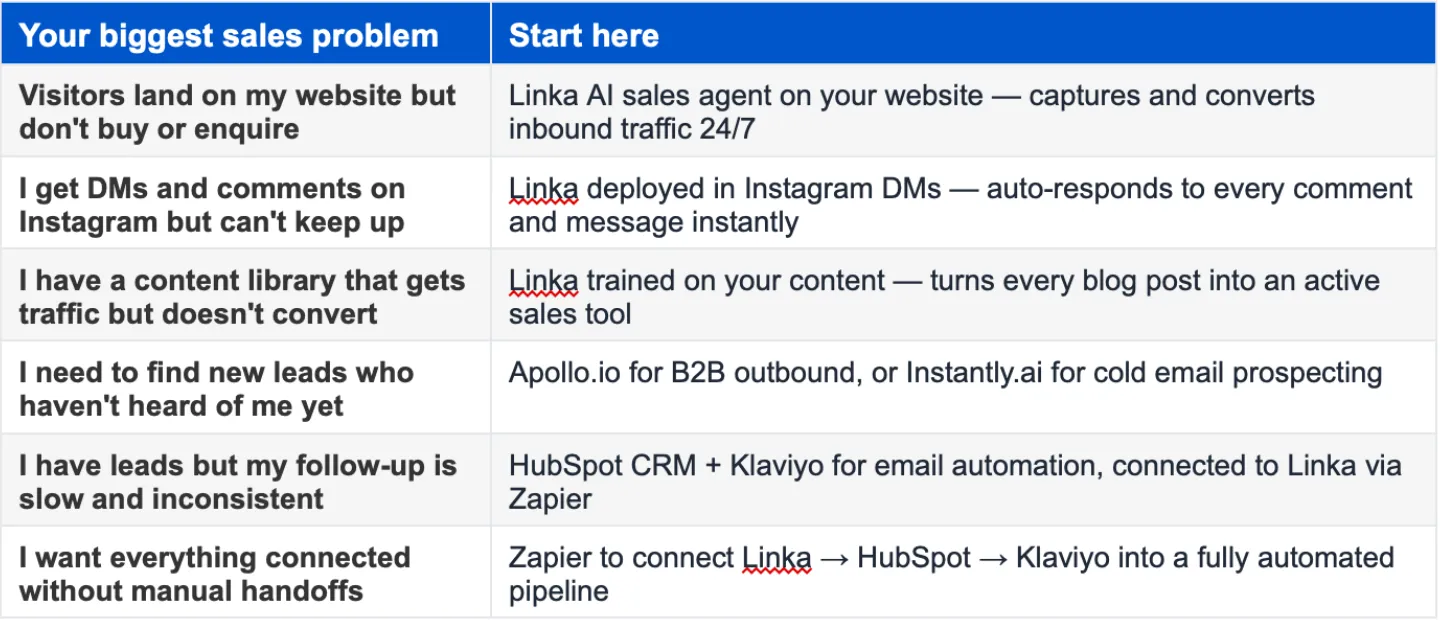
If you're just starting out and you're not sure which problem to solve first, pick the one that's costing you the most money right now. For most creators and small businesses with existing traffic or an audience, that's inbound conversion, and that means an AI sales agent is the highest-ROI first move.
Your biggest opportunity is monetising the audience you've already built.
The core stack: Linka on your website and Instagram DMs to handle questions and convert followers into buyers — then Klaviyo or a newsletter tool for email follow-up.
You don't need Apollo or Instantly. You're not doing cold outreach, you're converting warm attention. For more detail on this, see how custom AI is revolutionising affiliate marketing for creators.
Your bottleneck is usually lead qualification and booking.
The core stack: Linka on your website and LinkedIn to handle initial enquiries, qualify leads, and route them to your booking link — then HubSpot to manage the pipeline and follow up with leads that aren't ready yet.
Linka is particularly well-suited to service professionals because it can handle the nuanced back-and-forth of a services enquiry without you being present.
Your bottleneck is usually conversion rate and cart abandonment.
The core stack: Linka on your product pages to answer pre-purchase questions in real time — plus Klaviyo for abandoned cart emails and post-purchase sequences.
For businesses on Shopify, Linka integrates directly with your eCommerce setup and can recommend products, handle objections, and complete sales within the chat.
Keep it simple. One AI sales agent that handles your website, your DMs, and your lead capture covers 80% of what you need. Don't build a complex stack before you've validated that the fundamentals are working.
The core stack: Start with Linka, connect it to a free HubSpot CRM via Zapier, and scale from there once you're seeing results.
The whole framework for doing this is in our solopreneur's guide to scaling sales with AI.
Before signing up for anything on this list — or anything not on it — run through these questions:
Linka is built specifically for sales — not support, not productivity, not content creation. It's the platform for creators, coaches, and businesses who want to turn their existing audience and content into automated revenue. Start for free at linka.ai/pricing-plans.
The best AI tool for sales is the one that solves your most expensive problem first.
For most businesses reading this, that problem is somewhere between 'I'm losing visitors who never enquire' and 'I'm losing leads who never convert.' Both of those are inbound conversion problems, and they're exactly what an AI sales agent is built to solve.
The tools in this guide cover the full sales stack, from generating new leads to converting existing traffic to following up with buyers.
You don't need all of them. Start with the one that addresses your biggest gap, get it working properly, and build from there.