.webp)
.webp)
The best lead in your pipeline might be the one you don't know you lost. The person who found your site at 10:47 at night, read through your services, had a question they couldn't find an answer to, and quietly closed the tab. By morning, they'd booked a call with someone else. Not because your offer wasn't right for them. Because there was no chatbot lead generation system in place.
This is a more common problem than most service business owners realize. The standard client acquisition setup involves a contact form, a "get in touch" button, and a calendar link buried in the navigation. But this was built for business hours and patient buyers. It doesn't reflect how people actually research and make decisions online, which is often late, often fast, and almost always on their timeline rather than yours.
What Chatbot Lead Generation Actually Means
Chatbot lead generation is the practice of using automated conversational tools to capture, qualify, and route potential clients through the early stages of your sales process, without requiring a human to be present for every interaction.
When a chatbot is built well and deployed in the right places, it becomes the presence that's always available. It catches leads at the moment of highest intent, qualifies them before they move on, and routes the best ones forward in a way that makes your actual sales conversations shorter and more productive. Scaling sales through automation starts with understanding what that process looks like in practice.
The older model of online lead generation relies on forms. The newer model replaces the form with a conversation. The visitor asks a question, the chatbot responds immediately with something relevant and useful, and by the end of that exchange the visitor has either booked a call, received a resource, or been moved to the next step.
How Do Chatbots Actually Capture and Qualify Leads?
The qualification piece is where chatbot lead generation moves beyond basic automation and into something genuinely useful for your business. A well-designed chatbot doesn't just collect contact information. It surfaces the prospects most likely to convert and filters out those who aren't ready yet, before anyone has invested time in a discovery call.
The qualification happens through conversation. Rather than presenting a static intake form, an AI-powered chatbot asks questions that feel like a real exchange. The best qualifying questions for service businesses tend to follow a structure like this:
- The Situation Question: What are you working on right now, and what's the biggest thing standing in the way? This opens the conversation and surfaces context without feeling like an interrogation.
- The Scope Question: Are you looking for ongoing support or help with a specific project? This helps distinguish between prospects who need different offer types and routes them accordingly.
- The Timeline Question: How soon are you hoping to get started on this? Urgency signals tell you which leads need immediate attention and which can go into a longer nurture sequence.
- The Experience Question: Have you worked with a coach or consultant on this before? This tells you how much education the prospect needs and calibrates the conversation accordingly.
By the time the chatbot flags a lead for follow-up, you already know the context, the urgency, and whether the situation fits your offer. Your actual sales conversation starts from a much more informed position, which typically means shorter calls and clearer decisions on both sides.
The handoff moment matters just as much as the qualification itself. A good chatbot lead generation setup recognizes when a conversation has reached the point where a human needs to take over, and routes accordingly, whether that's a calendar link, a direct notification, or a trigger for your follow-up sequence.
The Difference Between a Chatbot and an AI Sales Agent
Not all chatbots work the same way, and the distinction has a real impact on how well your chatbot lead generation performs.
Rule-based chatbots operate on decision trees. If the visitor says a specific keyword or clicks a specific option, the bot delivers a pre-written response. These are predictable and easy to build. They also break down the moment a conversation goes somewhere the script didn't anticipate, which in practice happens constantly.
AI-powered sales agents work differently. They're trained on your specific content, your offer language, your frequently asked questions, and your brand voice. When a visitor says something unexpected, the agent understands the intent behind it and responds with something relevant, rather than defaulting to a fallback message that frustrates more than it helps.
For example, let’s say a business consultant has an AI sales agent live on their website. A visitor arrives and types: "I'm not sure if I need consulting or if I should just hire someone in-house." A rule-based chatbot would likely return a scripted prompt that doesn't address the actual question. An AI sales agent understands that this is a qualification moment and responds the way the consultant would, explaining the difference, asking what the visitor's specific situation looks like, and guiding them toward the option that fits.
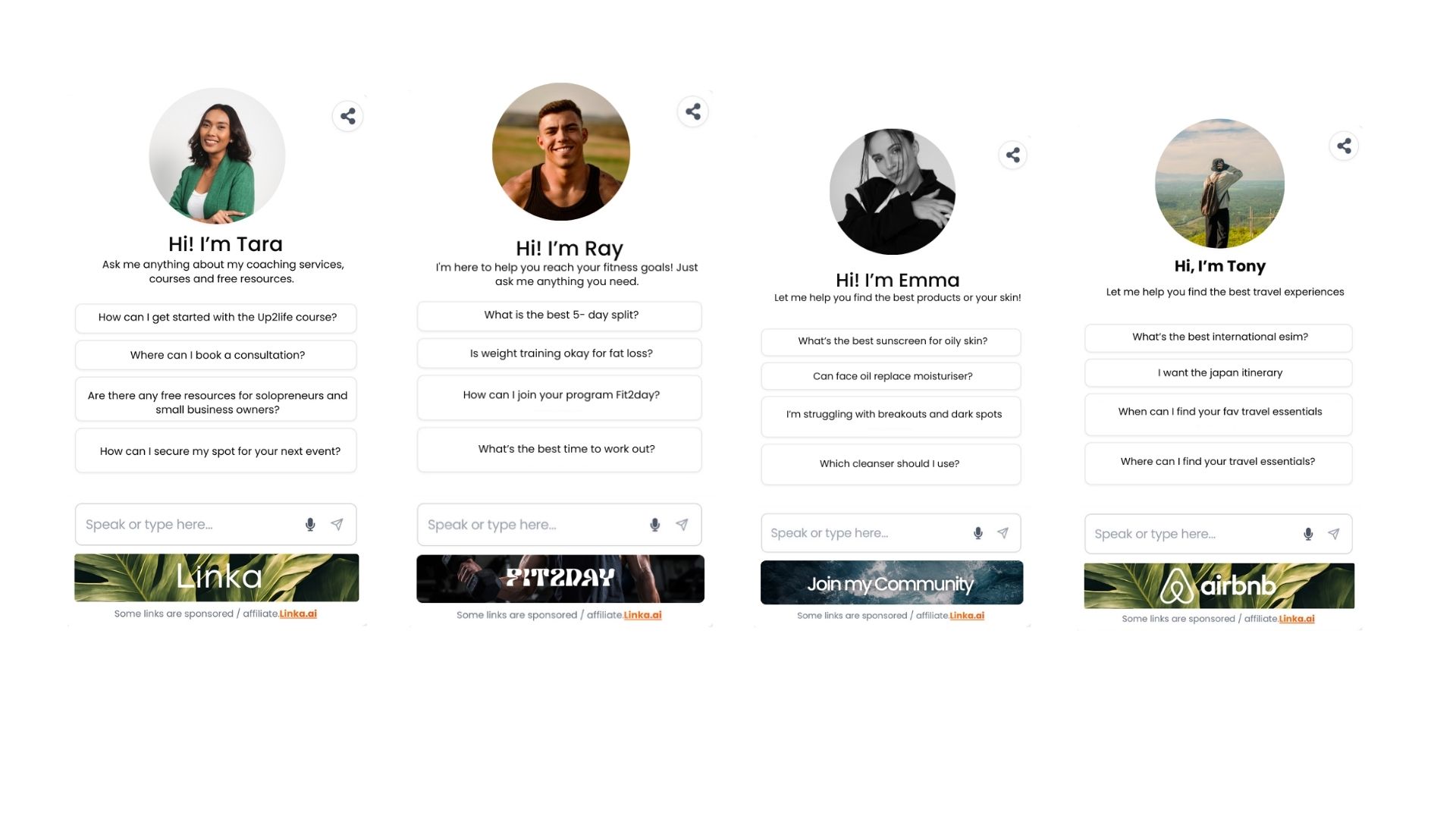
For service professionals, coaches, and creators who want chatbot lead generation that actually sounds like them, Linka's AI sales agents learn from your content and your offers so every conversation reflects your brand rather than generic automation language.
Where Should I Deploy Chatbot Lead Generation?
Placement matters as much as the chatbot itself. The goal is to put it wherever buying intent already exists, wherever someone might be on the edge of a decision and just needs a question answered or a clear next step.
The highest-value deployment locations for most service businesses are:
- Website Homepage and Service Pages: This is where visitors land with the most intent and the highest likelihood of converting if they receive a fast, relevant response. An AI agent here engages the prospect while their attention is fully on you.
- High-Traffic Blog Posts: Readers who find you through search are already researching solutions, which means they're partway down the decision path before they even arrive. A chatbot positioned within that content can capture intent before the tab gets closed.
- Instagram Bio Link: When someone clicks through from your social profile, they're expressing active curiosity. A conversational AI agent waiting on the other side of that click engages them immediately rather than leaving them on a static page with nowhere clear to go.
- Email Signature and Newsletter CTAs: A "chat with my agent" link inside an email reaches subscribers who are already familiar with your work, which tends to make this one of the highest-converting touchpoints available.
- Proposal and Pricing Pages: Visitors on these pages are often in active comparison mode. A chatbot here can answer the questions that are standing between them and a decision without requiring you to be available at that exact moment.
The consistent principle across all of these is immediacy. Chatbot lead generation works because it removes the wait between interest and engagement. Every location where that wait currently exists is a candidate for deployment.
What Separates Chatbots That Convert From Ones That Just Sit There
The difference between a chatbot that generates leads and one that generates friction comes down to a few consistent factors that are worth building into your setup from the beginning:
- Voice and Tone Alignment: A chatbot that sounds generic or scripted undermines the trust your content and positioning have already built. The agent should sound like it belongs in your brand, because it does.
- One Clear Primary Goal: The most effective chatbots are built around a single main action — booking a call, downloading a resource, or qualifying for a program. Too many options leave visitors unclear about what to do next and more likely to leave without doing any of them.
- Value Before Capture: Leading with a genuinely helpful response before asking for contact information changes the entire dynamic of the interaction. People share their details readily when they feel they've already received something worthwhile.
- A Defined Escalation Path: When a conversation signals high intent or a complex situation, the chatbot should know how to handle it — send an alert, route to your calendar, or trigger a personal follow-up — rather than cycling a serious prospect through automated loops.
- Ongoing Review and Iteration: Conversation logs are some of the most useful data a service business can have access to. They show exactly what questions your audience is asking, where objections form, and what your chatbot isn't answering well yet. Reviewing them regularly and updating the training accordingly is what turns a functional chatbot into a reliable lead generation engine.
How Do You Know If My Chatbot Lead Generation Is Working?
The metrics that matter are simpler than most people expect. Conversation start rate tells you how many of your site or bio link visitors are engaging with the chatbot at all. If this number is low, the chatbot's placement or opening message likely needs adjustment before anything else.
Qualification rate tracks what percentage of conversations are reaching the point where a prospect has been meaningfully assessed and is ready for a next step. A high qualification rate suggests the conversation flow is working. A low one usually means the questions are coming too early or the opening isn't compelling enough.
Handoff rate measures how often the chatbot successfully routes a qualified lead to a booking link, a follow-up sequence, or a direct notification. If conversations are ending without a handoff, something in the flow is breaking before the close.
Conversion rate is the share of chatbot conversations that ultimately result in a discovery call booked or an offer purchased. This is the number that connects chatbot lead generation back to actual revenue.
The qualitative layer matters just as much. What questions are appearing in conversations that the chatbot isn't handling well? What objections come up repeatedly that the current training doesn't address? Those gaps are a content roadmap and a training update list in one.
Start Capturing More Leads with Linka
A well-built chatbot lead generation system doesn't add to your workload. It removes the waiting, the manual follow-up, and the qualification calls that go nowhere. It replaces those with a process that runs while you focus on the clients you already have.
When you're ready to see what that looks like for your specific business, explore the Linka demo and find out how our team builds AI sales agents for service professionals, coaches, and creators that capture and qualify leads around the clock, in your voice.
The setup takes an afternoon. The upside is a sales channel that works while you sleep. Get started →
.webp)