
.webp)
.webp)
Somewhere right now, someone is saving a Reel about a coastal town they'd never heard of sixty seconds ago, and something in it lands. Eleven weeks later they're planning on checking into a hotel three streets back from that same stretch of beach, and there's almost no way left to prove the two moments belong to each other. That gap is where influencer marketing for travel brands loses its case.
The content performs, the saves climb, and the comments fill up. Yet the trip started with a creator and the booking arrived through a search bar.
The stretch between someone becoming interested and someone actually booking has one of the widest gaps in affiliate marketing. Understanding why that gap exists, and what can be placed inside it, changes what a travel creator campaign is capable of returning.
Why Influencer Marketing for Travel Brands Looks Like It Failed
Attribution windows across most creator platforms get set for retail behavior, where a person can see something, want it, and buy it before dinner. Travel doesn't work that way, so measuring it with a retail window produces a report describing something other than what actually happened.
Two separate timing failures tend to stack on top of each other, and each one hides a campaign's results on its own:
- Windows That Close Before the Booking: Research from Expedia Group puts the average trip consideration window at 71 days, which means a 30-day measurement period expires more than a month before the typical reservation gets made.
- Tracking That Expires Even Sooner: Hotel affiliate attribution depends on a tracking mechanism surviving from interest through to booking, and it often doesn't.Commission is earned only when a booking completes in the same browser session as the click.
- Payouts Timed to Checkout: Several hotel programs pay out on completed stays rather than confirmed reservations, which adds weeks more between the decision your creator influenced and the revenue event anyone can see.
What Happens Inside the Travel Booking Consideration Window?
Expedia Group's Path to Purchase research, conducted with Luth Research across a digital panel of more than 70,000 travelers and over 5,700 survey respondents in seven countries, breaks that 71-day travel booking consideration window into roughly 33 days of inspiration followed by 38 days of research and planning. Those phases behave nothing alike, and creator content does its heaviest lifting in the first one, where almost nothing is measurable.
The inspiration phase is also when most travelers have no idea where they're going. More than half of travelers either had no specific destination in mind or were weighing several at once, which is precisely the moment a creator's recommendation carries the most weight.
Somewhere inside all that browsing, the questions start:
- Whether the dates are available and what the property costs that specific week
- What's included in the nightly rate and what gets charged separately at the desk
- How the cancellation policy reads for a trip being booked months ahead
- How far the property sits from the airport, the beach, or anything worth walking to
- Whether it works for everyone traveling, including small children, older parents, or dietary restrictions
Not one of those questions gets answered by a link in a bio. This is where an automated DM campaign comes in.
Where Travel Buyers Ask the Questions That Decide a Booking
The questions surface wherever the trip idea is living, which means the comment section underneath the creator's post. That's the context the traveler already occupies, so that's where they ask, and both of the people who could actually answer are missing from the exchange.
The creator usually can't help. They might have stayed at the property once, so they know the view was worth it, but they have no idea how the cancellation terms read or whether the third floor has a lift or what an airport transfer runs at midnight. The brand isn't in that conversation at all. So the question either sits unanswered or picks up a friendly guess from another follower, and the traveler leaves to find out somewhere more reliable.
How Should Travel Brands Measure a Campaign That Pays Out in Month Three?
The first fix costs nothing, which is setting the attribution window to match the category rather than accepting a default built for retail. Given a 71-day average, 90 days is a defensible floor, and the decision needs making before creator contracts get signed, because it changes payment terms and reporting cadence at the same time.
The second fix is giving up on the single revenue number and measuring the phases separately instead. Staging the measurement gives destination marketing ROI something to stand on months before bookings arrive:
- Days 0 to 14: Track saves, shares, story replies, and DM volume. These are inspiration signals, and they tell you whether the content reached people with a genuine reason to travel.
- Days 15 to 45: Track referral sessions, guide downloads, enquiry forms, and newsletter signups against creator-specific tracking. This maps to the research phase, and movement here predicts bookings far better than anything you saw in week one.
- Days 46 to 90: Track booking-adjacent activity and confirmed reservations. Revenue finally shows itself here, long after most programs have closed the report and moved on.
Running several creators at once across a 90-day window introduces a real risk of double-counting, so decide in advance whether first touch or last touch takes credit. It's also worth auditing the cookie window travel bookings genuinely depend on, since a generous setting in your own dashboard means little when the network underneath it expires the session in an hour.
Making Influencer Marketing for Travel Brands Start in the Comments
Widening the window helps you see revenue you were already earning. It doesn't help you earn more of it. The bookings lost inside those 71 days were mostly lost to unanswered questions, and answering them means being present the moment they're asked rather than two days later.
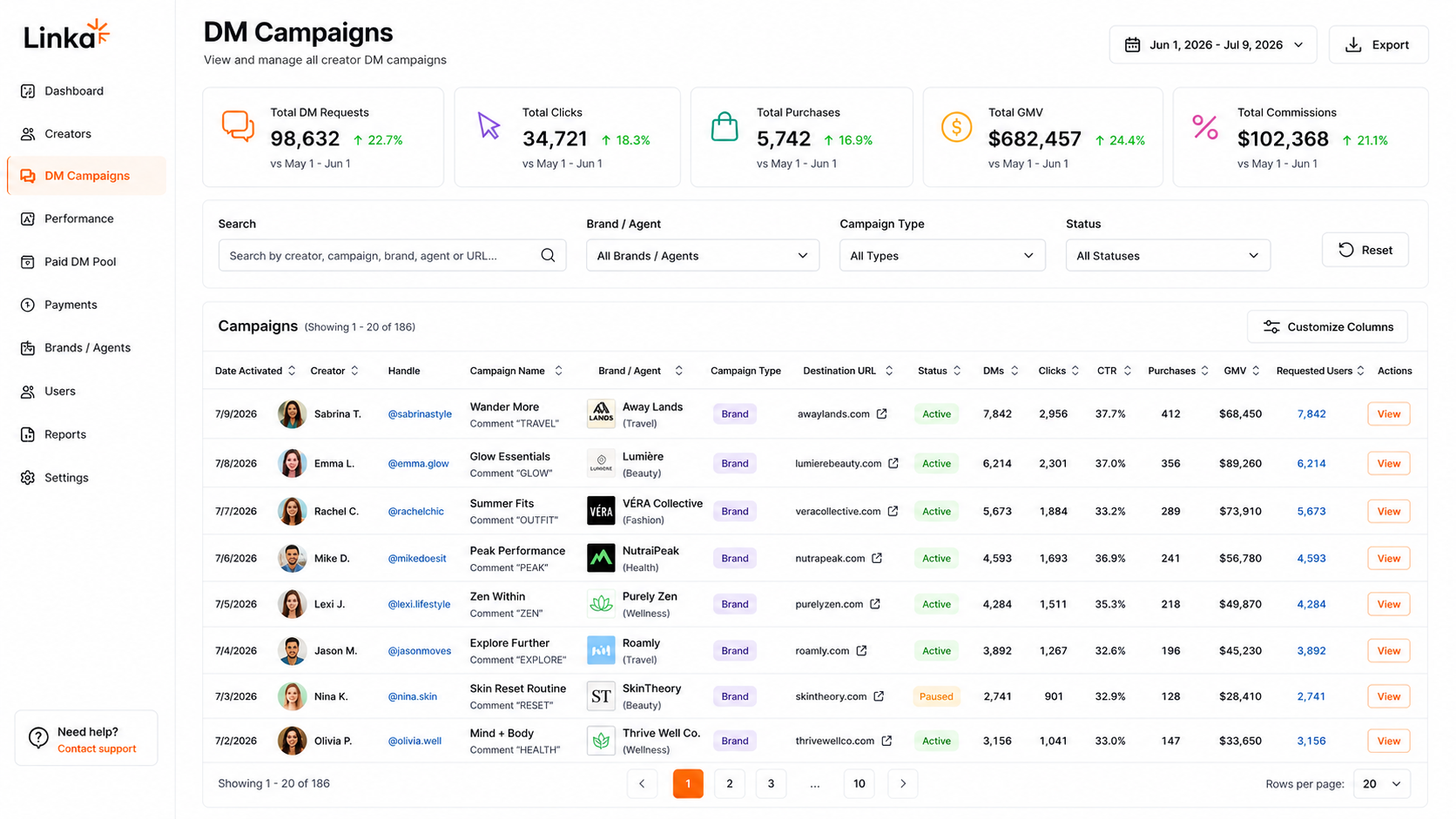
That's the part our platform was built around. Linka runs Meta-approved Comment-to-DM campaigns, so when someone comments on a creator's Reel about your property, a personalized Instagram DM arrives within seconds, and the agent behind it already holds your rates, room types, policies, and the answers your reservations team gives out forty times a week. The traveler asks about the terrace room and the family of four, and gets a straight answer while the trip is still an idea they're excited about.
The qualified conversation becomes a measurable event in its own right, which is what Cost Per DM was built to price, and it happens weeks ahead of anything a booking engine would record. Brands reward creators at twenty-five cents per qualified DM alongside affiliate commissions on the bookings that follow, so creators keep answering long after a post stops trending. Plus, Linka comes with analytics so you can see which creators are performing the best.
Frequently Asked Questions About Influencer Marketing for Travel Brands
What attribution window should travel brands use for creator campaigns?
Ninety days is a sensible floor, and longer suits international or long-haul destinations where planning stretches further. With the average trip consideration window running 71 days, anything shorter than 60 days will close before most bookings are made. Set the window before signing creator contracts, since it affects payment terms as well as reporting.
Why don't travel affiliate cookies capture most bookings?
Because the booking rarely happens in the same session as the discovery. A traveler who leaves to compare options and returns days later arrives untracked. Given that travel decisions average more than two months, session-based attribution misses most of what creator content actually influenced.
Can influencer marketing for travel brands be measured before a booking happens?
Yes, and it's the more useful approach for a decision cycle this long. Qualified conversations, meaning travelers asking real pre-booking questions about dates, rates, or suitability, are trackable within days of a post going live. Those conversations are strong leading indicators of reservations, and they can be priced and paid on directly rather than waiting three months for a revenue figure.
Ready to See How Influencer Marketing for Travel Brands Works?
Travel and hospitality sit among the categories Linka works with the most. We can put your brand in front of a network of 18,000+ creators. You set the affiliate commission, reward creators twenty-five cents per qualified DM, and watch qualified DMs, clicks, bookings, commissions, and GMV land in a single dashboard rather than three reports that close before your guests check in.
Ready to stop losing bookings in the eleven weeks between the Reel and the reservation? See how performance-based creator campaigns work for travel and hospitality brands, or book a call and we'll map out what your first campaign could look like.
.webp)
.jpg)
.jpg)