.webp)
.webp)

Scroll through almost any creator's feed and you'll find the same thing at the bottom of most captions. A few emoji, maybe a couple of hashtags, occasionally a "link in bio" that assumes rather a lot of the reader. Even when viewers enjoy content, they often pass without being asked to do anything. Learning how to write an Instagram CTA that drives DMs is mostly about closing that gap between attention and action.
The gap costs more than it looks. Sprout Social's research found that influencer content now outperforms brand-owned content across reach, engagement, and conversion, which means your recommendation genuinely carries weight with the people watching. Attention isn't usually the constraint for creators. The ask is.
Two creators with similar audiences produce wildly different conversation volume, and the difference comes down to whether anyone was invited into a conversation at all.
What an Instagram CTA That Drives DMs Has to Overcome
Writing the ask is harder than it sounds because the format works against you in several specific ways, and none of them are obvious until somebody points them out.
The obstacles are worth naming individually:
- Caption Truncation at 125 Characters: Instagram cuts your caption after roughly 125 characters and hides the rest behind a "more" tap that most people never take, so an ask sitting at the bottom of a long caption might as well not exist.
- Muted Viewing: A large share of your audience watches Reels with the sound off, which means anything you only say out loud reaches a fraction of the people who saw the post.
- The Four-Step Bio Journey: "Link in bio" asks someone to leave the post, find your profile, tap a link, then locate the right thing on a page listing everything else you're currently promoting. People drop off at every one of those steps.
- Vague Instructions: Asks like "let me know what you think" give no specific action, so nobody performs one. Specificity is what makes a request answerable.
- Timing Mismatch: The moment of highest interest is while someone's still watching, and any ask that requires them to act later is competing with the next post in the feed.
An Instagram caption call to action has to clear all five of those at once, which is why the ones that work look so different from the ones most creators default to.
What Makes a Keyword Trigger Actually Get Typed?
Asking someone to comment a specific word is the mechanic that turns a viewer into a conversation, and small choices about that word change how many people follow through.
The triggers that get typed reliably share a few traits:
- One word rather than a phrase, since comments get typed fast and longer strings get mistyped
- Written in uppercase in your caption so it reads as an instruction rather than part of a sentence
- Specific to the content, connecting clearly to what the person just watched
- Distinct from ordinary conversational words, because a trigger like "love" will fire on every compliment
- Identical across your caption, your on-screen text, and whatever you say out loud
Specificity matters as much in the promise as in the word. "Comment GUIDE for tips" tells nobody what they're getting. "Comment GUIDE and I'll send you the full breakdown" names the thing. The test is whether a stranger could describe what they're about to receive before they type anything.
For example, a fitness creator posted a Reel about the exact resistance bands she travels with. Her original caption ended with "everything's linked in my bio." The post did well and produced almost no clicks. She reposted a similar Reel weeks later ending with "Comment BANDS and I'll send you the set I actually use," and the comment section filled with the word BANDS. Same creator, same product, same audience. The only variable that changed was whether anyone had been asked.
Where Should the Ask Appear in Your Reel?
Placement does as much work as wording, and the answer is that the ask belongs in more than one place at once. Redundancy isn't clutter here. It's coverage, because no single placement reaches everyone who watched.
Put the trigger in the first two lines of your caption so it survives truncation. Say it aloud in the Reel for the people who never read captions. Add it as on-screen text for the ones watching muted. Then pin a comment from your own account repeating it, which catches anyone arriving weeks later through recommendations rather than their feed.
Unconnected reach keeps delivering a post long after you've moved on, so a pinned comment carrying the ask is the only thing still working when someone finds the Reel in month four.
Good Reels CTA examples tend to sound like something you'd actually say. "Comment SHADE and I'll tell you which one I use" reads like an offer. "Link in bio for more information" reads like a form.
Writing an Instagram CTA That Drives DMs Worth Having
Here's the part most advice skips. Getting the comment is only half the job, and the half that gets all the attention. What arrives in the DM decides whether that comment turns into anything.
A single link dropped into a message is a marginally faster version of your bio. The person who just commented is at peak interest and almost always has a second question, which might be about sizing, price, whether it works for their situation, or whether there's something better. If your first message is a bare link, that second question has nowhere to go, and the conversation ends where the sale should have started.
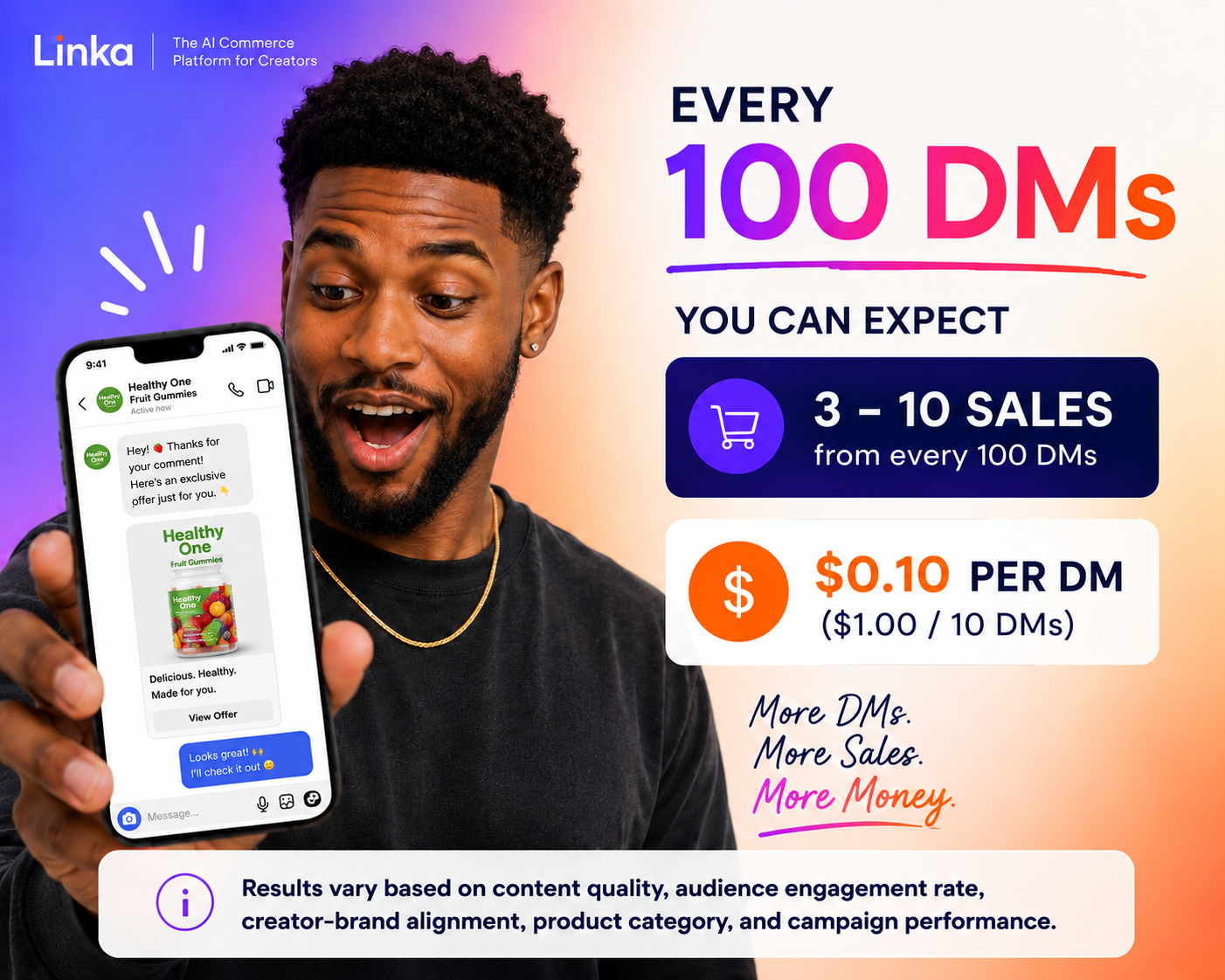
DM Campaigns on Linka are built around that second question. You create a Reel, Story, or Live, configure your comment to DM keyword trigger, and test the whole experience before you publish anything. When someone comments, Linka sends a personalized Instagram DM through Meta-approved automation containing product recommendations, shopping links, and your AI Shop, which can keep answering after the first message lands. That's where DM conversion for creators actually happens, in the exchange rather than the delivery.
The earning structure follows the same logic. Participating brands pay for qualified DMs your content generates, and affiliate commissions arrive on top when someone buys, so a single keyword campaign produces two revenue streams from one post. Tracking every stage means you learn which asks worked rather than guessing, and the next caption gets written with better information than the last one.
Start by fixing one caption. Pick a post you're planning this week, choose a word, promise something specific, and put it where people will actually see it. That's the entire experiment, and it takes about four minutes.
Creator Questions on How to Write an Instagram CTA That Drives DMs
What should I write in my caption to get more comments?
Ask for one specific action and say what the person gets in return. A single uppercase keyword paired with a clear promise outperforms open-ended prompts, because it removes the guesswork about what to type and why. Put it in the first two lines so it survives caption truncation, and repeat it on screen and out loud in the video.
What makes a good keyword trigger?
Short, unambiguous, and connected to the content. Single words beat phrases because people type quickly and get phrases wrong. Avoid common conversational words that will fire on ordinary compliments. Whatever word you choose has to match exactly across your caption, your on-screen text, and what you say in the video, since any mismatch means people type the wrong thing.
Why isn't my link in bio converting?
Usually because it asks for too many steps at the wrong moment. Someone interested in a specific product has to leave the post, open your profile, tap through, and then find that product among everything else you're promoting. Each step loses people, and the interest fades with every tap. Delivering the answer directly into their DMs with Linka removes the journey entirely.
Turn Your Next Reel Into a Conversation That Pays
You've got the caption formula. Linka handles what comes next. Set up a Meta-approved DM campaign, create your Linka Shop, pick your keyword, and every comment triggers a personalized Instagram DM carrying your recommendations, shopping links, and an AI Shop that keeps answering after the first message lands.
Choose from 12,000+ brands across travel, beauty, fashion, wellness, and food, then earn on qualified DMs and affiliate commissions from one post. Your dashboard tracks clicks, purchases, and payouts in real time, and it's free for active partners.
Ready to turn your comments into conversations that pay? Activate your creator partnership and set up your first keyword campaign.
.webp)