
.webp)
.webp)
If you’ve been shopping for “AI” for your business lately, you’ve probably noticed that almost every tool calls itself AI, whether it’s a simple FAQ bot or a full-on chatbot customer service agent.
That confusion is a problem, because what you actually need depends on your goal. If you’re trying to reduce support tickets, the right AI sales tool looks very different from what you’d use to generate leads and book clients.
What Is Chatbot Customer Service?
Customer service chatbots are the OG “bots for business.” They’ve been around for years, and you may have already used them.
At a basic level, a customer service chatbot is:
- A software widget that sits on your website or inside a support portal.
- Built on rules or flows: if user says X, or clicks Y, respond with Z.
- Designed primarily to reduce the load on your support team by answering repetitive questions.
Think of things like:
- “What are your business hours?”
- “Where’s my order?”
- “How do I reset my password?”
- “What’s your refund policy?”
The chatbot’s job is to deflect as many of those questions as possible away from human agents. It improves response time for simple queries and cuts down on ticket volume.
What Are the Pros and Cons of Chatbot Customer Service?
The strengths of customer service chatbots include:
- Great at structured, repetitive questions.
- Cheap to run at scale.
- Easy to measure (tickets deflected, average handling time).
- Ideal for FAQs and basic troubleshooting.
However, its limitations include:
- Struggling with complex, multi-step issues.
- Breaking when users go off-script or ask nuanced questions.
- It can feel robotic and frustrating when someone actually needs help from a human.
So if your goal is primarily support efficiency (e.g., fewer tickets, faster responses to simple questions), a chatbot is often the right tool. But if your goal is revenue (e.g., more leads, more calls, more clients), that’s where things change.
What Is an AI Sales Agent for Customer Service?
An AI sales agent looks similar on the surface (it’s still a chat bubble), but under the hood it’s very different.
Instead of being a glorified decision tree, an AI sales agent:
- Uses a large language model (LLM) that understands natural language and context.
- Is trained on your specific content — services, pricing, FAQs, case studies, testimonials, and even blog posts.
- Holds open-ended conversations that can wander, branch, and circle back like a human chat.
A good AI sales agent will:
- Answer questions about your offers, not just your policies.
- Ask smart follow-up questions to understand someone’s situation.
- Recommend the best program/product for them.
- Capture lead information (name, email, context) during the conversation.
- Drop your booking link or checkout link at the right moment — not at random.
In other words: customer service chatbots are built to make support cheaper. AI sales agents are built to turn conversations into sales.
Side-by-Side: Customer Service Chatbot vs. AI Sales Agent
Here’s the clearest way to see the difference.
Example of Both Chatbot Customer Service and an AI Sales Agent
Let’s say someone runs 1:1 coaching practice and recently added a customer service chatbot to their website after seeing a competitor use one. The bot handles a few basic questions — "How do I book a call?" and "What's your refund policy?" — but that's about it.
A potential client lands on the site at 11 PM, curious about the 12-week program. They type, "I've tried other coaches before and it didn't work — how is yours different?" The chatbot can't handle it. It either loops them back to the FAQ menu or displays a generic "I'll connect you with a human agent" message. The visitor bounces. This results in a missed opportunity.
Now imagine the same scenario with an AI sales agent. The agent reads the message, acknowledges the concern, and responds: "That's a really common fear — let me ask you a couple of things so I can give you an honest answer." It asks about past experience, identifies the gap, walks the potential client through how the coach’s methodology is different, and — when the timing is right — drops the discovery call link. By morning, there's a new booking on the calendar.
When is Chatbot Customer Service the Right Solution?
You should only use a traditional chatbot when:
- Your main pain is support volume, not sales.
- You have lots of simple, repetitive questions clogging your inbox.
- Your sales motion is straightforward and already working.
- You just want a front line that handles basics and routes complex issues.
Here are some examples:
- E‑commerce store dealing with “Where is my order?” all day.
- SaaS tool answering setup questions and pointing to help docs.
- Membership site where people constantly ask how to reset passwords.
In those cases, customer service chatbots are perfect. They take pressure off your support team, give fast answers to simple questions, free humans to focus on complex, high-empathy issues. If your biggest bottleneck is post-purchase friction, a support chatbot is a great investment.
When Is an AI Sales Agent the Right Tool?
You should be thinking AI sales agent — not support chatbot — when:
- You’re getting interest (traffic, DMs, clicks), but not enough bookings.
- Prospects ask nuanced, open-ended questions before they ever buy.
- Your offers require explanation and match-making (which program is right?).
- You want to capture and qualify leads 24/7, not just during office hours.
This is exactly where Linka lives. Linka’s AI sales agents are built for:
- Coaches, consultants, and experts.
- Creators with audiences on Instagram, TikTok, LinkedIn, newsletters.
- Service businesses that rely on conversations to convert.C
Instead of answering “where’s my order,” they’re answering:
- “Is this program right for someone in my situation?”
- “How is your approach different from other coaches I’ve tried?”
- “What if I can’t make the live calls?”
- “Do you offer payment plans?”
Then they ask a few questions to understand fit, recommend the best offer, capture details, and share your booking link or checkout URL. It’s not there to keep customers away from you; it’s there to bring more of the right ones closer.
Why This Difference Matters So Much for Revenue
If you opt for chatbot customer service when you actually needed a sales agent, here’s what happens:
- You get a decent FAQ assistant.
- It still can’t handle the real decision-making conversations.
- You’re left manually answering nuanced questions in DMs, email, and calls.
- Your pipeline looks the same, just with a new widget on your site.
On the flip side, if you try to throw a sales agent at deep, post-purchase support, you’re misusing a powerful tool. That’s better handled by support processes and humans.
The key is matching tool to job:
- Support goal → customer service chatbot.
- Revenue goal → AI sales agent.
For coaches and consultants especially, the main business constraint is rarely support. It’s almost always a lack of qualified leads, no booked discovery calls, and too much time lost in early-stage back-and-forth. Those are exactly the problems AI sales agents like Linka were built to solve.
How Linka Fits in Without Being Just Another Bot
Linka positions itself very clearly as an AI sales agent, not a generic chatbot.
That shows up in a few ways:
- It’s trained on your offers, content, and voice — not just a FAQ list.
- It’s designed to work across website and Instagram DMs, link-in-bio, and other channels where your audience already is.
- Its core motions are: answer, recommend, capture, book, and sell — not just deflect.
Here are some typical Linka use cases for coaches and consultants:
- A visitor lands on your site at 10 pm, chats with your agent, and books a call.
- An Instagram follower comments “INFO” on a Reel — your agent takes it from there, in DMs, and guides them to the right program.
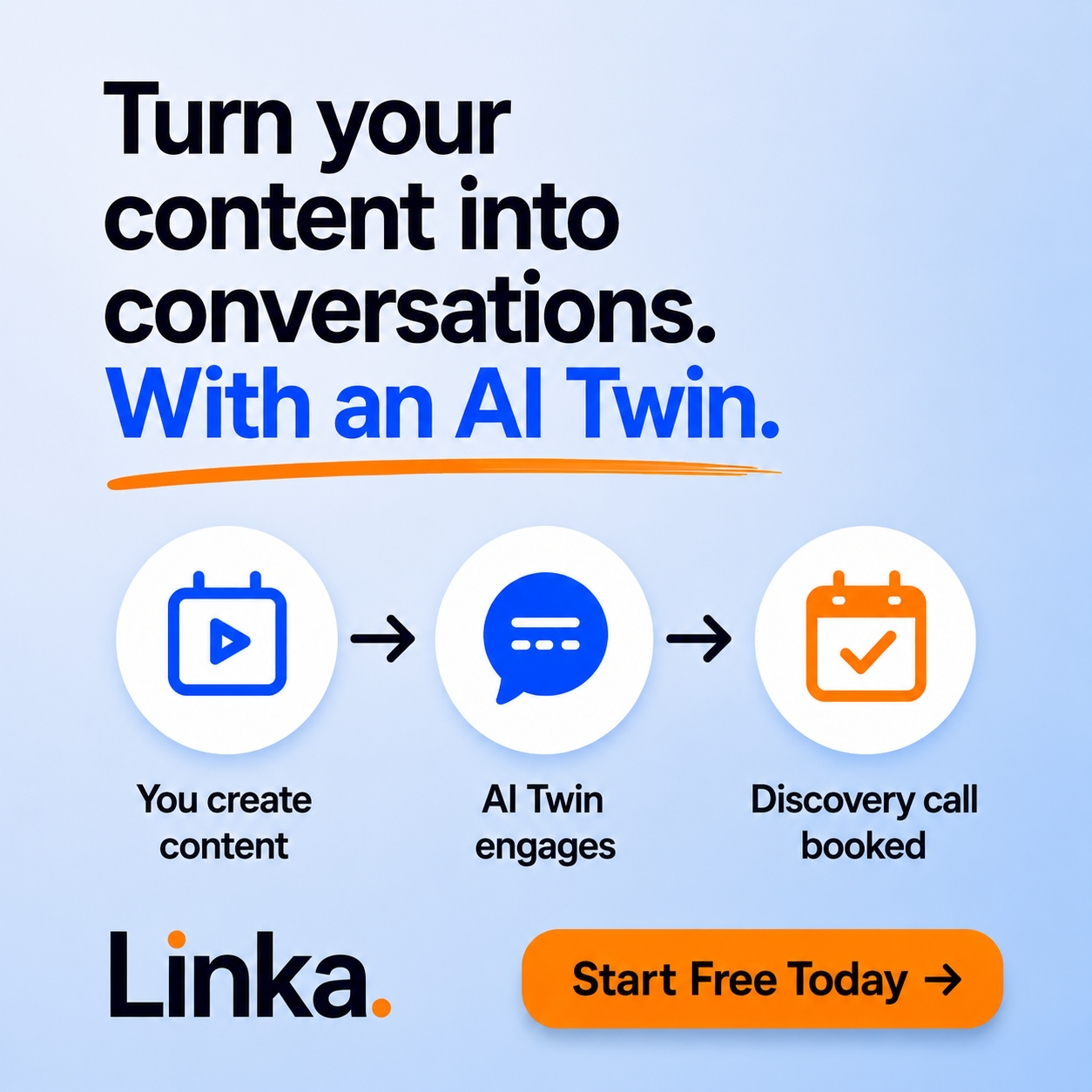
- Someone taps your link-in-bio — instead of a static link list, they meet a conversational “AI twin” that asks what they’re looking for and routes them appropriately.
Can You Use Both? (Hybrid Setup)
Bigger or growing businesses often get the best results from a hybrid setup. A customer service chatbot can be used to handle order issues, tech support, and account changes. An AI sales agent can handle inbound leads, product/program questions, and bookings.
The rule of thumb is:
- If the question is “I already bought, now I need help” → support chatbot.
- If the question is “I’m thinking about buying, but I have questions” → AI sales agent.
For most solo coaches and small consulting firms, though, you don’t need both on day one. If the biggest push you need is more leads and more booked calls, an AI sales agent gives you the highest ROI on effort.
How to Decide Which One You Need Right Now
Ask yourself a few blunt questions:
- What hurts more: support or sales?
- Constant tickets and support load → chatbot.
- Not enough qualified calls and clients → AI sales agent.
- Where are you personally spending most of your time?
- Fixing customer issues → support tools.
- Answering “how does this work?” questions in DMs → AI agent.
- What’s your next revenue unlock?
- Serving existing clients more efficiently?
- Or converting more of your existing audience into paying clients?
If you’re a coach, consultant, or expert, odds are your bottleneck is on the sales side, not technical support. That’s where chatbot customer service falls short and AI sales agents shine.
Compliment Your Chatbot Customer Service with an AI Sales Agent
Customer service chatbots and AI sales agents look similar from the outside — same chat bubble, same general vibe — but they’re built for totally different jobs.
Chatbots answer basic questions, deflect tickets, and keep support costs down. AI sales agents have real conversations, qualify leads, recommend offers, and help you close more business.
If your goal is to grow and not just to handle volume, you probably don’t need a chatbot. You need a sales-focused AI agent that understands your business and can sell alongside you.
That’s what Linka is designed to do. It takes the repetitive, first-layer conversations off your plate, so more of your website visitors and social followers turn into booked calls and clients — without you living in your inbox and DMs.
The setup takes an afternoon. The upside is a sales channel that works while you sleep. Get started →

.webp)