.webp)
.webp)

“Comment for the LINK and I’ll send it to you” might be the most-typed sentence on Instagram this morning. A fashion creator says it after a try-on haul. A home account says it under a sofa reveal. Your favorite lifestyle creator has almost certainly said it already today, probably twice. The line works for generating affiliate revenue. People comment, the creator sends a link, and somebody buys.
Here’s the small tragedy folded into that routine. Most of the people saying it do the exact work of a salesperson and get paid like a volunteer. They create the desire, field the questions, dig up the link, and the retailer keeps the whole sale. Learning to turn “comment for the link” into affiliate revenue is mostly a matter of fixing that one imbalance, and it is far easier than it sounds.
The distance between a friendly habit and an income stream is short. It comes down to what kind of link you send and what is sending it for you. You don’t need to be famous. You need an audience that already asks, and a simple system to answer them while you sleep.
What Turns “Comment for the Link” Into Money?
Affiliate marketing turns “Comment for the Link” into revenue, and if that phrase calls up images of spammy coupon sites, the creator version is cleaner than the reputation suggests.
An affiliate link is an ordinary product link with a bit of tracking attached. When your follower taps it and buys the blazer, the retailer knows the sale came from you and pays you a commission — a slice of the purchase — while the follower pays nothing extra.
This is the engine behind most creator income that doesn't depend on brand deals. A sponsorship pays once, for one post, at a rate someone else decides. Affiliate commissions pay on performance, across everything you post, for as long as the content keeps getting found. The same haul Reel can earn for months as new viewers arrive, comment, and buy. Nobody has to approve you talking about a brand you already love. You simply need an affiliate relationship with it.
For creators, the implications are hard to ignore. For example:
- You're already sending links at the single highest-intent moment in your entire funnel.
- Sending an unmonetized link in that moment is like running a shop and forgetting to install the till.
- Every link you hand over could be earning, and most of them earn nothing at all.
- Finding programs, generating links, and answering comments are operations problems, not talent problems.
- Talent you can't outsource. Operations you can.
- That repetitive labor (e.g., link generation, the comment replies, the program management) is exactly what software now handles better than a person typing at midnight.
Build the Whole "Comment for the Link" Pipeline
Picture the system end to end, with a fashion creator as the example. She posts a Reel styling one pair of wide-leg trousers five ways. In the caption and the voiceover, she says “comment TROUSERS and I’ll DM you everything.” Followers comment. An automated comment-to-DM campaign answers each one privately with a link, no copy-paste, no midnight marathon of typing “sent!” The link points either to the exact product or to her storefront, where the trousers sit beside the rest of the outfit.
Every item is an affiliate offer, so each purchase pays her a commission, and the Reel keeps circulating while she sleeps.
That pipeline has four parts, and each rewards a little care.
- Invitation: Be specific about what commenting earns them. “Comment TROUSERS for every piece in this look, sizing notes included” beats a vague “comment for info.”
- Automation: The DM has to arrive within moments, because a link request has a short shelf life, and this is precisely the job a comment-to-DM campaign exists to do.
- Destination: A single product link converts best when the want is specific, while a storefront works better for hauls and full looks, so keep both ready.
- The offer layer underneath: Behind every link should sit an affiliate relationship, so a click and a purchase produce revenue rather than a warm feeling.
Measure It Like a Shopkeeper
Once the pipeline runs, watch it the way a shopkeeper watches a till, gently and weekly. Three numbers tell almost the whole story. Comments per campaign show whether the content created any desire. Clicks on the delivered link show whether the DM landed well and arrived fast enough. Purchases show whether the product, the price, and your credibility all lined up.
When revenue disappoints, one of those three layers is usually the culprit, and the numbers point straight at it. A campaign with hundreds of comments and almost no clicks has a DM problem, probably one of speed. A campaign with plenty of clicks and almost no purchases is usually a product or price mismatch. You don’t need dashboards full of charts. You need those three checkpoints, once a week, read with an honest eye.
The keyword counts double as a free focus group. If TROUSERS pulled five hundred comments and your accessories campaign pulled thirty, your audience just told you what it wants to buy next. Let that steer the content calendar, and better-aimed content produces more requests, which produce more conversions, which sharpen the data again. The loop tightens on its own once you start reading it.
There is a second use for keyword data that most creators miss entirely. The comments act as a content brief. A campaign where TROUSERS pulled five hundred comments and BOOTS pulled twenty-eight is telling you exactly what to film next. The audience has ranked your categories for you without being asked.
When the next Reel goes up on the topic that already pulled hard, it arrives in front of an audience that has already demonstrated it cares, which means more comments, more automated DMs, more commissions, and stronger algorithmic signals.
Where Linka Fits
This is the stack Linka packages into one free partner program, so the four parts stop being four separate subscriptions.
The Comment-to-DM Campaigns
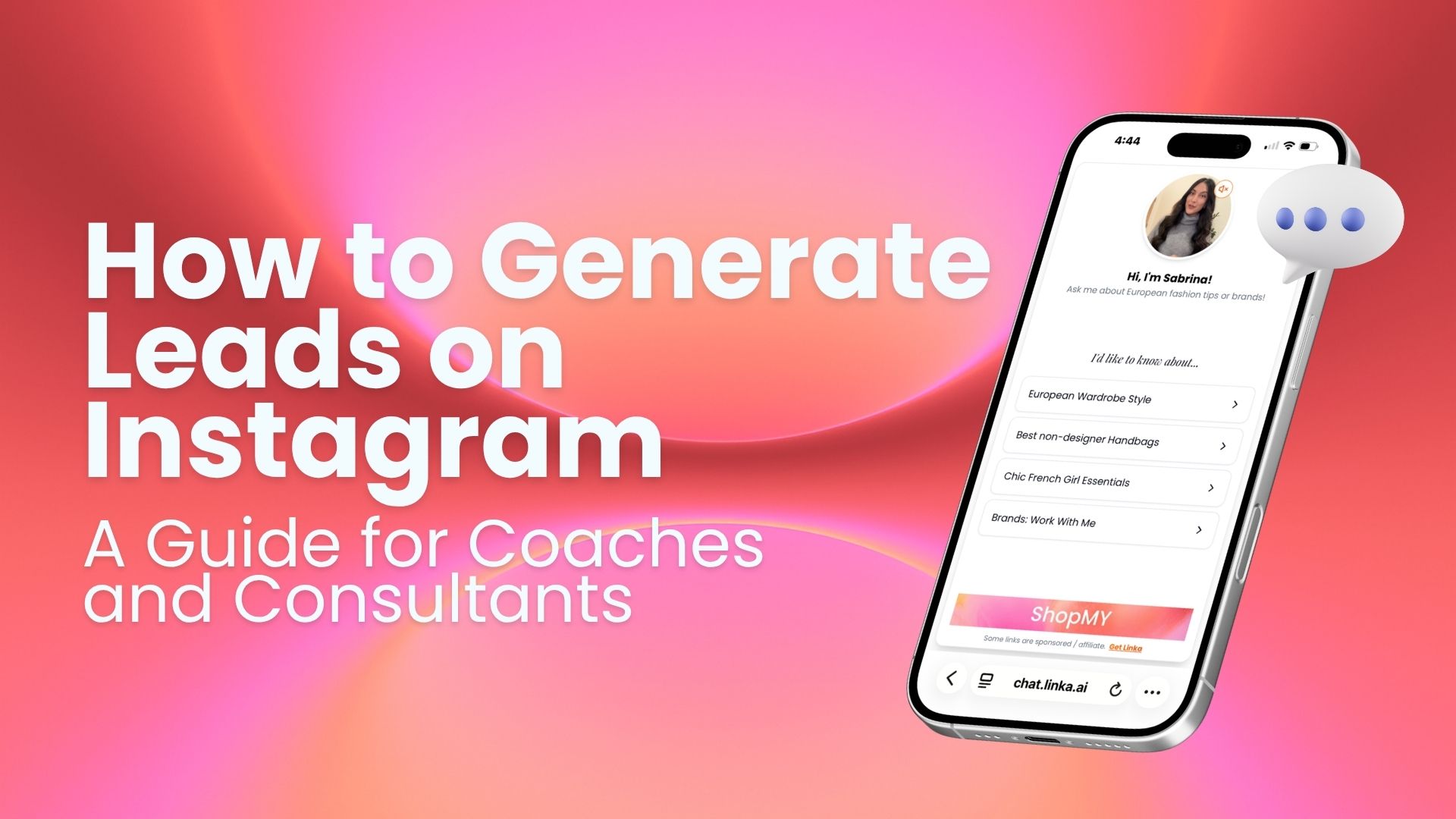
A Linka Store gives you the shoppable destination, one page holding your curated recommendations. AI Sales Agents handle the conversational layer, so when a follower replies “would these work for petite frames?” the question gets a helpful answer and a relevant offer instead of three days of silence.
That carries more weight than it sounds. A standard keyword trigger fires a canned message when someone comments a specific word. An AI agent reads the content inside your Reels and answers follow-up questions using what was actually in the video. When a follower replies "would these run small?" after getting the link, the agent doesn't go quiet or send them back to the link they already have. It responds with sizing context drawn from your content and, where relevant, surfaces a related offer.
The difference between a scripted flow and a genuine conversation is the difference between a vending machine and a shop assistant, and it is why comment campaigns that use the AI layer tend to convert better than ones that stop at the link drop.
The Offer Layer
You get access to more than 32,000 brand offers across fashion, beauty, lifestyle, home, travel, health and wellness, and pet, which means the products your audience already asks about can usually be linked as earning offers without applying to programs brand by brand. You earn when your audience clicks, shops, books, or buys through a supported offer. Performance-based, around the clock, with no brand deal required and no minimum level of fame.
None of this asks you to change how you make content. You film the haul, you answer the sweet messages personally when you have time, and the system catches everything you can't.
An affiliate link inside a good Reel doesn’t expire when the post leaves the feed. The trousers video from last spring keeps surfacing, keeps pulling comments, and the campaign keeps answering them with a link that still pays. Old content stops being an archive and becomes a back catalog that earns, which is something a sponsored post can never do.
The Pipeline Runs Past Instagram
"Comment for the link" lives on Instagram, but the affiliate infrastructure underneath it doesn’t have to. Linka works across websites, newsletters, YouTube, TikTok, and LinkedIn, which means the same store and the same agent that answers a Reel comment can also serve a reader who lands on a blog post six months from now and wants to know where the coat is from. A newsletter mention routes subscribers to the same shoppable agent. A YouTube description drop works through the same earning system.
The Reel is the ignition point for most of this since it generates the volume and the urgency, but the commission potential extends to every channel where someone can find the recommendation and tap a link.
Keep It Honest, Keep It Working
Affiliate revenue runs on trust, and trust has rules. Break them and the whole engine seizes, because followers stop believing your recommendations, and the recommendations are the product. Three habits keep it intact:
- Recommend only what you would defend in person, so an honest “skip this one” makes every “buy this one” land harder.
- Disclose that your links may earn a commission, which costs nothing and reads as confidence rather than confession.
- Match how often you ask to how much value you are actually offering.
Fit is the quirk worth respecting in fashion especially. Clothing gets returned more than almost anything else bought online, and a returned order helps nobody, least of all your credibility. The fix is the unglamorous detail work your audience loves you for. Honest sizing notes lower returns, raise the odds a follower keeps and loves the piece, and turn a one-time buyer into someone who trusts your next pick sight unseen.
Frequency matters too. If every post demands a comment, the mechanic goes numb. Save the keyword campaigns for content where you genuinely have something worth sending, the full sources list, the complete look, the thing forty people already asked about. One or two campaigns a week, wrapped in ordinary storytelling, keeps the selling occasional and the serving constant. The audience never starts to feel like a field being harvested.
Start Generating Affiliate Revenue with Linka
What is encouraging about all of this is how little it asks you to change. You already make the content. Your audience already comments. The links already get sent. Turning that loop into affiliate revenue is mostly a matter of swapping the plumbing underneath it, from free labor to a tracked, automated, commission-paying system.
So start small. Pick the one product your audience asks about most, set a single keyword campaign on your next post about it, and watch the three numbers come back. “Comment for the link” will be typed millions of times today no matter what. The only open question is whether your version of it pays you.
Your audience is already asking, so join the Linka Partner Program for free and let it answer, recommend, and earn on your behalf.

.webp)