
.webp)
.webp)
Ask any marketing team what their last creator campaign cost and you'll get an answer in seconds, down to the invoice number. Ask what a customer acquired through that campaign cost and the room gets quiet, because they never set up the tracking that would answer the question. Customer acquisition cost is the number that decides whether a campaign made money, and in creator marketing it's the number that doesn't get calculated enough.
That silence isn't carelessness. It's what happens when a channel's payment model and its measurement model point in different directions, and creator marketing has lived with that mismatch since the first sponsored post. The teams running these campaigns are usually excellent at measurement everywhere else, which makes the gap even more striking when you notice it.
Why Is Customer Acquisition Cost Invisible In Creator Campaigns?
Every other performance channel reports its acquisition cost as a matter of routine. Search, paid social, and email all connect spend to customers because the buying happens on trackable surfaces. Creator campaigns end differently, with a report full of exposure metrics and a revenue line nobody can confidently attach to it. When customer acquisition cost never appears, renewal decisions run on reach and rapport instead of returns, and the problem sits in what gets measured and what gets skipped.
A typical post-campaign report includes plenty, just not the part that matters most, including:
- Impressions and reach, which describe exposure
- Engagement rate, which describes attention
- Link clicks, which describe curiosity
- Promo code redemptions, which capture a slice of purchases at best
- No count of customers acquired, and no cost attached to each one
Without that last line, you can't compare the campaign to your search spend, defend the budget to your finance team, or know which creators to rebook. Measure creator campaign performance without an acquisition number and every renewal decision runs on instinct.
The pressure to close this gap is rising from the finance side of the building. Marketing leaders who once defended creator spend as brand investment are increasingly asked to justify it in the same acquisition terms as every other channel, and the reports they inherit weren't built to answer that question. The channel didn't get less effective. It got more scrutinized, and scrutiny finds the numbers that are missing.
What Does The Calculation Look Like On A Typical Deal?
For example, take an illustrative flat-fee campaign at $5,000 for a single sponsored post. Say it earns 80,000 impressions, a two percent click-through sends 1,600 people to a landing page, and the page converts at somewhere between one and three percent. That range produces between 16 and 48 customers, which puts the customer acquisition cost anywhere from roughly $104 to over $300 per customer. The spread alone is a problem, and most brands will never know where in it they landed because there’s a disconnect between the purchase data and the campaign.
At the high end of that range, the campaign may cost several times more per customer than the brand's other channels, and nobody in the room will know to adjust. At the low end, the campaign might be a bargain worth scaling aggressively, and nobody will know that either. These figures are illustrative, but the structure of the problem is universal. Creator campaign ROI can't be managed when its central number is a guess, and a guess with a threefold spread isn't a number at all.
Why Does Traditional Attribution Keep The Number Hidden?
With traditional Instagram affiliate attribution, the number stays hidden when the buying journey moves and the tracking doesn't follow. Shoppers watch a Reel, ask a question in a DM, and purchase later on a different device, while influencer marketing attribution still depends on last clicks, UTM tags, and promo codes. Last-click models hand the credit to whichever coupon site appeared at checkout. UTM parameters get stripped when shoppers hop from the Instagram app to a browser. Attribution windows close before considered purchases finish, and the DM conversation where the decision actually formed never appears in any report at all.
None of this is a technology failure so much as a model failure. When you pay for a post, you're buying exposure with no mechanism to trace what it produced, so the customer acquisition cost stays hidden by design. The payment model determines what gets tracked, the tracking determines what gets reported, and the reporting determines what gets funded, which is how an entire channel ended up optimizing for the metrics that matter least.
What Changes When You Pay Per Conversation Instead?
Linka prices creator campaigns around the qualified DM, and that single change makes the acquisition number visible while the campaign is still running:
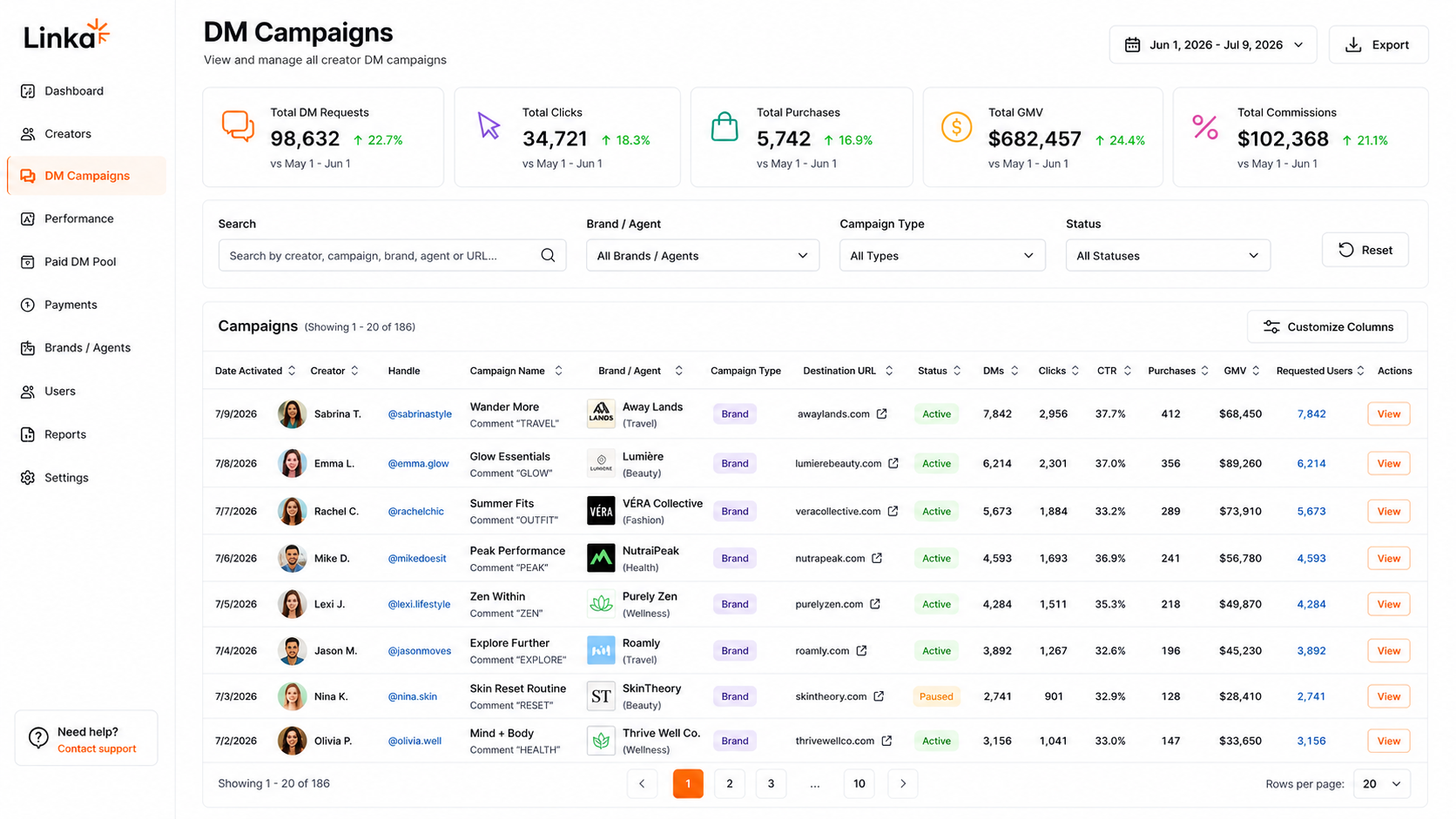
- Qualified DM Tracking: Every conversation a creator's content generates gets counted and tied to its source, so the stage between content and checkout finally produces data.
- Live Campaign Analytics: Qualified DMs, clicks, purchases, commissions, and GMV report in real time, letting you adjust budgets mid-campaign instead of reading a postmortem.
- Creator-Level Attribution: You see which creators generate conversations that convert, so rebooking decisions rest on acquisition performance rather than follower counts.
- Connected Commissions: Affiliate earnings link back to the conversations that produced them, closing the loop between what you paid and who you acquired.
Comparing cost per DM vs CPM ultimately comes down to whether you'd rather price the exposure or the decision. Pricing the decision means your customer acquisition cost updates with every conversation and every purchase, live, while there's still time to act on it.
Frequently Asked Questions About Customer Acquisition Cost In Creator Marketing
What numbers should a campaign brief include before launch?
Three at minimum. A target acquisition cost based on what a customer is worth to you, an expected volume of DM conversations from the creator's audience, and the conversion rate the campaign needs to stay profitable. If those aren't written down before launch, success can't be judged after it.
Can acquisition cost really be tracked in real time?
Yes, when the payment unit is the conversation. Because our platform counts qualified DMs and connects them to purchases as they happen, the cost per acquired customer updates live instead of being reconstructed weeks later from partial promo code data.
Does this replace promo codes and affiliate links?
It completes them. Codes and links still capture conversions, while conversation tracking fills in the stage they miss, so your reporting covers the journey from content to question to purchase rather than just the final step.
Make Customer Acquisition Cost A Number You Actually Know
Customer acquisition cost shouldn't be the mystery at the center of your creator budget.
Linka connects qualified conversations to purchases, commissions, and spend in one live dashboard, so every campaign answers the question your reports have been avoiding and every creator relationship gets valued on what it actually produces. The next budget conversation gets easier when the acquisition number is on the screen instead of in dispute.
Launch a brand program with us and put a real number behind every customer your creators bring in.

.webp)