.webp)
.webp)

Every marketing budget is, in some way, a bet on what to pay for. Somewhere along the way, someone decided that a thousand impressions were worth a certain amount, or that a single click justified a certain price, or that only a completed sale should trigger a payment at all, and none of those decisions were arbitrary. They reflected what each era of marketing actually had the ability to measure before the rise of cost per DM (CPDM™).
We think about this constantly at Linka, because the brands and creators we work with are always trying to figure out what they should be paying for and paying attention to. The answer keeps shifting, and understanding why explains where things are heading next, toward conversations as the unit of value and the direct message as the most honest signal a buyer sends.
How Marketing Priced Attention Before the Rise of Cost Per DM
The earliest digital pricing models borrowed heavily from television and print, where advertisers paid for exposure because exposure was the only thing anyone could reliably count. That's where cost per mille (CPM) comes from. A brand pays a set rate for every thousand times an ad is shown, regardless of whether anyone looks at it, clicks it, or remembers it five minutes later.
CPM made sense in a world where reach itself was scarce. Getting in front of a large audience once required serious budget, so achieving that reach felt like an accomplishment worth pricing on its own. The problem is that exposure was never a promise that anyone cared, and as feeds grew crowded, each impression represented a thinner slice of real attention.
Cost per click (CPC) emerged as a step toward accountability. Instead of paying to be seen, brands paid only when someone took an action by clicking a link. That felt like progress, because a click at least required a person to make a small decision, but a click never proved anyone wanted to buy. Plenty came from curiosity, accidental taps, or people who left the page within seconds.
Why Cost Per Action Still Left Money on the Table
Cost per action (CPA) tightened things further by charging only when someone completed a specific outcome like a purchase or a signup, and for direct response campaigns it remains useful. The limitation shows up everywhere else, because a lot of valuable buyer behavior happens well before any purchase, in comment sections and inboxes that never trigger a CPA event but still represent real, measurable interest.
Consider a furniture brand promoting a new sofa line through creator content. Someone might comment asking about fabric options, save the post to compare with other sofas, and send a DM asking about delivery timelines, all without clicking through or purchasing inside any tracking window. Under a pure CPA model, none of that counts, even though it's a shopper actively working through a decision.
Each model in the sequence exists because the one before it left something unmeasured:
- CPM Pays for Visibility: A brand pays for the chance to be seen, with no guarantee anyone registered the message at all.
- CPC Pays for Curiosity: A brand pays once someone clicks, though a click alone confirms attention rather than intent.
- CPA Pays for the Finish Line: A brand pays only on a completed action, which is precise but blind to everything leading up to it.
- CPE Pays for Real Interaction: A brand pays for the comments, keyword triggers, and messages that show someone actively considering, which is where decisions actually form.
Seen this way, CPDM™ isn't a trend so much as the next answer to a thirty-year-old question about what interest is worth.
Why the Direct Message Sits at the Top of the Engagement Ladder
Not every interaction carries the same weight. A like takes almost no effort and barely qualifies as a decision. A comment takes more thought, and a save suggests planning. A direct message, though, means someone decided a conversation was worth having, which tends to happen right before someone is ready to buy. The channel itself keeps growing to match, since Adweek reports that more than a billion people connect with business accounts every week across Meta's messaging apps.
This ranking has a practical consequence for anyone pricing engagement. If a DM is the strongest signal available, then a CPDM™ model anchored on DMs is the closest marketing has ever come to paying for intent directly. It also explains why so many teams are retiring the vanity metrics that merely look impressive.
There's a fairness dimension too. When payment follows conversations, the creators whose audiences actually respond finally out-earn the ones who only deliver reach.
How Linka Built a Marketplace Around the Rise of Cost Per DM
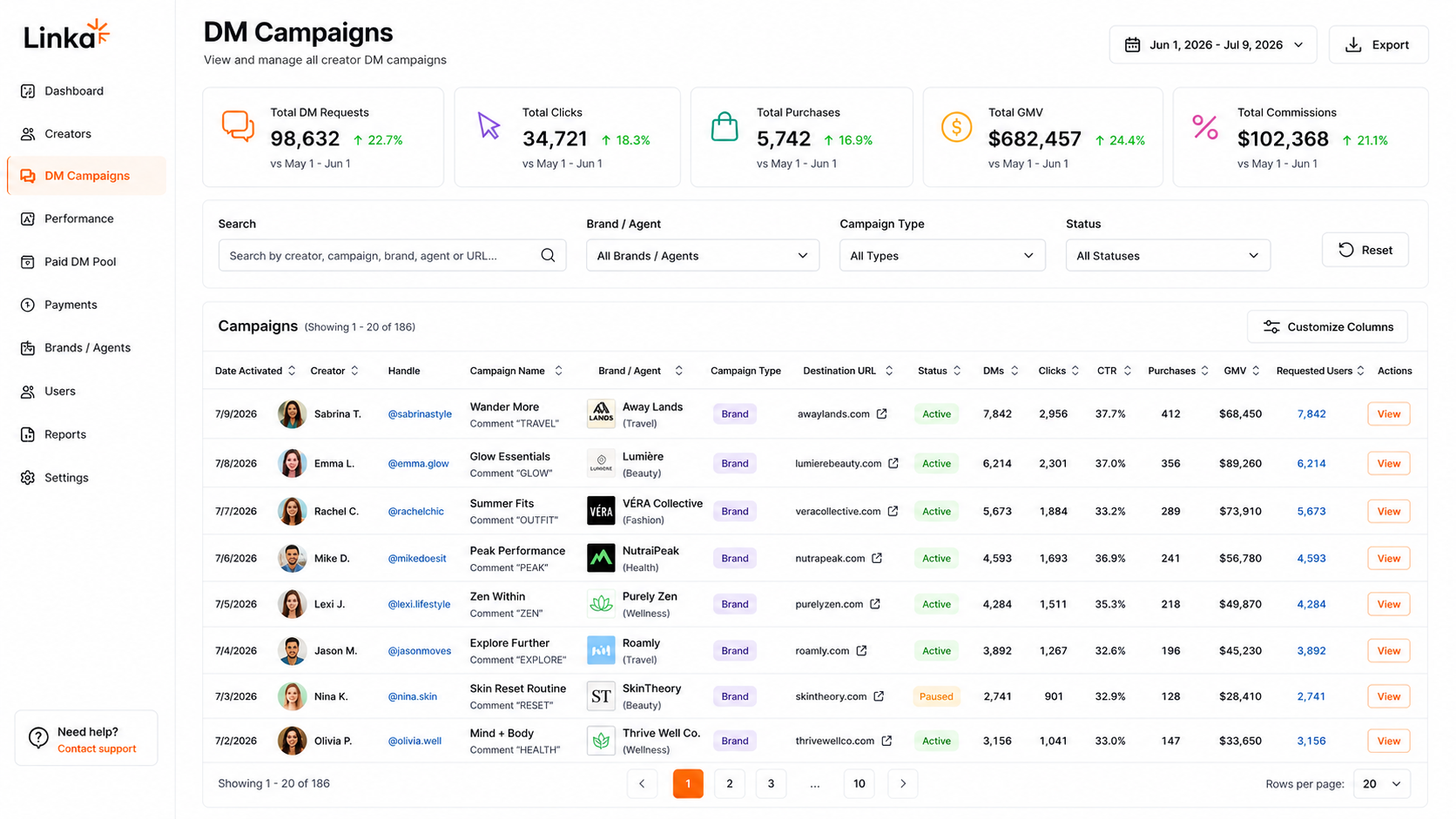
CPDM™ is the model our platform runs on rather than a metric we bolted onto a dashboard. Brands partner with Linka and pay per DM instead of per impression or per click. Creators across the network publish content featuring those brands, their audiences comment with campaign keywords, and each keyword triggers an intent-based DM that answers the question and carries a click straight to the brand's site. The person receiving the message asked for it seconds earlier, which is why these conversations convert the way cold placements never did.
For example, when a beauty brand joins the network, its offers become available to thousands of creators at once. A creator posts a tutorial and tells viewers to comment SHINE for the product link. Every SHINE comment fires a DM within seconds, every DM is a priced, tracked engagement, and every click that follows arrives warm. There's no briefing calls, no manual outreach, and no guessing which impressions mattered.
The second layer runs continuously in the background. Each creator can build their own AI, a personalized sales agent trained on their content that chats with followers and recommends chosen partner brands through their DMs and Shop. An AI sales agent like this is essentially a tireless recommendation engine wearing the creator's voice, and it's a large part of how custom AI is rewriting the affiliate playbook, since brands get promoted inside trusted conversations at all hours without buying a single impression.
What brands can expect from the model in practice:
- Priced on Conversations: Budgets map to actual DM exchanges with interested people, so spend scales with expressed intent rather than ad inventory.
- Distribution Across Thousands of Creators: Linka's AI matches offers to relevant audiences across the network, which already includes thousands of partner brands and a growing roster of global names.
- Evergreen Performance: Campaign posts keep triggering keyword DMs for as long as they stay live, so acquisition continues long after launch week.
- Conversation-Level Attribution: Every message ties to the clicks, leads, and sales it produced, replacing modeled attribution with observed behavior.
How to Calculate and Benchmark Your CPDM™
Total spend on a campaign divided by the number of DM conversations it generated gives you a CPDM™, the same way total spend divided by clicks gives you a CPC. What takes more judgment is deciding what counts as a fair benchmark, since a single number in isolation doesn't tell a brand whether it's paying too much or getting a bargain.
A few factors tend to move that benchmark more than anything else:
- Product category, since a considered purchase like travel or furniture naturally draws more pre-buy questions than a low-cost impulse item, which pushes conversation volume and CPDM™ in different directions
- Campaign intent, because a keyword campaign built to answer a specific question converts differently than one designed mainly to build awareness around a launch
- Creator tier, since a smaller creator with a highly responsive audience can produce a lower CPDM™ than a larger one with passive followers, even at a higher headline rate
- Time in market, because a post's CPDM™ often improves the longer it stays live and keeps triggering evergreen DMs against the same original spend
- Offer clarity, since a keyword tied to a specific, well-understood offer tends to draw more decisive comments than a vague prompt asking people to "learn more"
None of these factors have a universal right answer, which is exactly why benchmarking works best against a brand's own campaign history rather than an industry-wide number. The first campaign sets the baseline, and every one after it is a chance to see which creators, offers, and keywords consistently pull CPDM™ down.
What This Means for How You Budget Going Forward
CPM, CPC, and CPA all still have a place depending on what a campaign is trying to accomplish, and nobody needs to burn their existing media plan. But treating those older models as the whole picture means ignoring the layer of engagement where buying decisions actually form, in the comments and messages that fire before any click or conversion gets counted. Budgets that make room for CPDM™ consistently find their cheapest intent there.
Cheap attention is expensive the moment you need it to act.
Questions Brands Raise When Pricing Moves to DMs
Does This Replace Our Existing Ad Spend?
It doesn't have to, and treating it as an all-or-nothing decision usually delays the learning. CPM and CPC placements can keep doing what they do while a defined budget slice tests conversation-priced campaigns, and the side-by-side comparison tends to make the next budget decision for you.
How Is a DM Conversation Actually Priced?
Brands set their own commission terms when they join the network, then pay for the DM conversations and results their offers generate rather than for impressions or clicks along the way. Because every exchange is tracked to its outcome, the effective price of each conversation is visible rather than modeled, and our Pricing Plans lay out the specifics for different scales.
What Kinds of Brands Does This Work Best For?
It tends to work best for brands with a product people ask questions about before buying, which covers more categories than it sounds like at first. Fashion, beauty, wellness, travel, and home goods all generate the comment-and-DM behavior the model is built to price, since shoppers in those categories routinely want sizing details, ingredient lists, or availability before they commit. Brands selling something more commoditized with little pre-purchase research can still participate, but the conversation volume, and the return on it, tends to scale with how many real questions a product naturally invites.
The Rise of Cost Per DM Is Here. Get Started with Linka!
Putting CPDM™ to work starts with connecting what you already have. A brand links its product catalog and offers, sets commission terms, and Linka's AI begins placing those offers into real-time conversations across the creator and publisher network, both through keyword DM campaigns and inside creator agents and Shops. Creators, meanwhile, connect their content, pick their favorite brands, and start earning from the conversations their posts were already generating.
Attention was never really the product. The conversation always was, and now it finally has a price tag that makes sense. To see it in action, book a call with Linka, and when you’re ready to get started, take the next step in setting up your affiliate account.

.webp)