.webp)
.webp)

Most visitors to your website and social media channels won't fill out your contact form. They'll read halfway down a page, feel a flicker of interest, and close the tab without leaving so much as an email address. The gap between "curious" and "converted" is shorter than it looks, and a static page can't do much to bridge it. For most creators, coaches, and brands, that gap shows up as missed DMs, unanswered questions, and visitors who never come back — not because they weren't interested, but because no one met them in the moment. This begs the question: “How do chatbots qualify leads?”
Instead of waiting for someone to take action, an AI sales agent starts the conversation the moment visitors show up. That conversation, built around thoughtful questions and smart conditional logic, sorts your visitors into groups: ready now, needs nurturing, or genuinely not a fit. By the time a lead reaches your calendar, the basic discovery has already happened.
Linka was built for this moment. When your audience lands on a page, opens a DM, or follows a link, they deserve something better than a form and a waiting game. Here's how chatbot-based lead qualification actually works, and why it changes the math on scaling your sales.
What Does It Actually Mean to Qualify a Lead?
A lead isn't just anyone who lands on your page or hits play on a video. A qualified lead is someone who has a real problem, understands enough about your solution to recognize it, has the capacity to act, and carries some sense of timing. Without those signals, even a compelling offer tends to stall.
In a manual process, your team uncovers these details through direct conversation. On a discovery call or over email, you probe the problem, gauge urgency, and figure out whether this person can actually make a decision or is just gathering information. That's a solid process. The challenge is doing it consistently at scale, across every page visitor, every DM, every social media click.
With an AI sales agent handling the first round of questions, that discovery runs automatically. The agent listens, asks follow-ups, and routes people accordingly. “Ready now” gets a calendar link. “Needs more context” gets a resource and a soft follow-up. “Not a fit” gets a graceful exit that still leaves a good impression. Nothing slips through the cracks because the agent never gets tired or distracted. Instead of relying on one-off calls and scattered forms, you get a consistent, 24/7 qualification layer that turns conversations into revenue.
Most well-designed qualification flows center on four key signals:
- The specific problem they're trying to solve
- How urgent that problem feels today
- Whether they hold decision-making authority
- What scale or budget they're working with
Once your agent knows those four things, it can make intelligent routing decisions rather than sending everyone to the same generic page.
How Do Chatbots Qualify Leads Using Data?
Automatic lead qualification starts with a well-placed question. When an AI agent opens with "What brought you here today?" or "What are you trying to solve right now?", it invites context rather than demanding it. People share more in a natural conversation than they ever would in a checkbox survey. That difference in information quality changes everything downstream.
With Linka, the agent isn't pulling from a generic database. It's trained on your website, catalog or service menu, FAQs, case studies, and sales pages so it can respond in your voice and with your full product or service knowledge. This is what distinguishes Linka's AI sales agents from basic chat widgets that only surface canned answers. They understand your specific offers and guide people toward the right one in real time.
The mechanics behind this usually follow a similar pattern:
- Open-ended entry questions that let people describe their problem in their own words
- Follow-up prompts that probe timing, goals, or budget range
- Conditional logic that routes different answers toward different outcomes
- Natural lead capture moments that appear once a clear fit has emerged
On the surface, it just feels like a helpful conversation. Under the hood, your lead generation system is running.
For example, let’s say a service professional finds your page through a social post. They're interested but have specific concerns about timeline. Instead of bouncing off a static FAQ, they type a quick question. Your AI agent asks what they're working on, learns it's a time-sensitive project, shares a relevant case study from a similar engagement, and offers a 20-minute discovery call. By the time you check your calendar that afternoon, there's a new booking from someone who already has context. None of that required you to be online at that moment.
That's the real power of chatbot-based lead qualification. It’s not just about getting more leads; it’s about better-prepared conversations that start with mutual understanding rather than cold introductions.
What Should Your Lead Qualification Flow Actually Ask?
When you're building a qualification flow, you're deciding what your agent should listen for and how it should respond. It's less about loading in sales frameworks and more about mapping the questions you already ask in real discovery conversations.
Think in terms of four categories:
- Problem clarity. What is this person trying to fix, improve, or build? This determines which offer or resource is actually relevant. Without this, your agent defaults to a generic pitch that resonates with almost no one.
- Timeline insight. Are they exploring options for months from now, or actively trying to solve something this week? Timing shapes how the conversation should end. Someone early in research should leave with a relevant piece of content and a soft follow-up prompt. Someone ready to move should leave with a booking link.
- Fit and segment. For creators and affiliates, fit signals look different than they do for coaches and consultants or for an ecommerce brand running product campaigns. Your agent needs enough context to route the person accurately rather than defaulting to the same starting page for everyone.
- Capacity to act. Not everyone who shows interest has the authority or bandwidth to move forward right now. A question like "Are you exploring this for yourself or working with a team?" surfaces this without feeling like an interrogation.
When these signals are built into your chat logic, the quality of your pipeline changes noticeably. You get less noise and more conversations that begin with genuine alignment. It also means fewer calls spent figuring out whether there's even a fit.
This is also what separates an AI sales agent from a basic FAQ bot. A bot answers questions based on what they share, because it understands your catalog, your tone, and which problems your offers are actually designed to solve.
How Do Chatbots Qualify Leads Across Different Business Types?
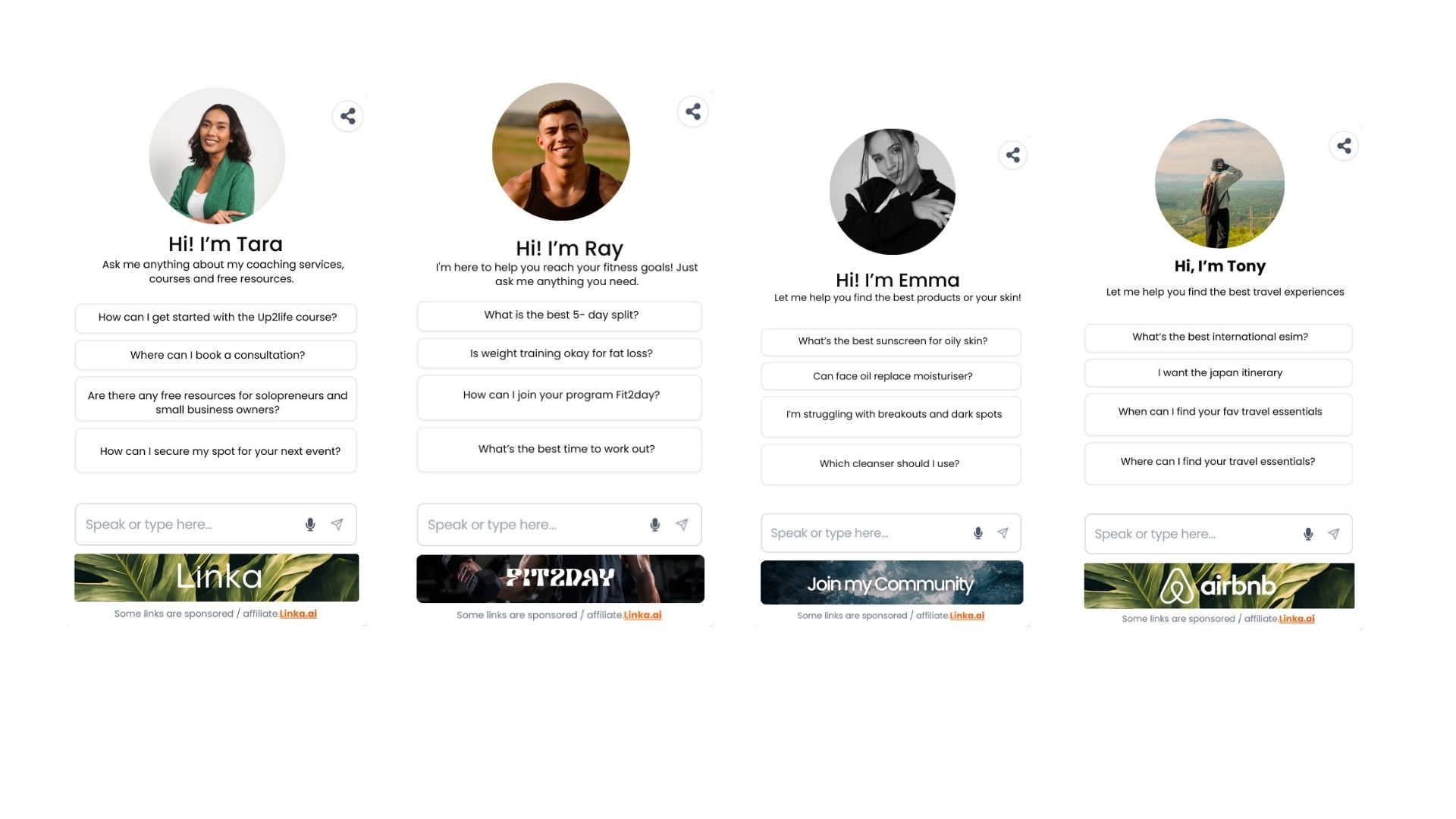
Lead qualification doesn't look identical for every audience. A coach booking high-touch programs cares about different signals than a creator building affiliate funnels or an ecommerce brand managing product campaigns. An effective AI sales agent reflects those differences rather than forcing everyone through the same generic script. Here are some examples across different business types:
- Creators and Affiliates: Qualification flows often focus on audience size, platform mix, monetization goals, and content style. The agent might ask whether someone drives traffic primarily through DMs, email, or video,
- Service Professionals: The conversation leans into current challenges, desired outcomes, timeline, and investment range. The agent routes people toward discovery calls, proposal flows, or specific packages depending on what they share.
- Ecommerce and Business Teams: Useful signals often include order volume, tech stack, campaign goals, and support needs. High-intent visitors get pointed toward demos; smaller-scale customers get self-serve resources.
- Affiliate Marketers: The focus lands on niche, traffic sources, and promotion style, so the agent can surface relevant partner offers and capture contact details for deeper follow-up.
Because Linka lets you build custom AI agents tuned to each of these segments, you can host distinct qualification experiences across your site, landing pages, and community spaces without juggling multiple separate tools. Each agent knows its audience and routes accordingly, so the nuances of each group are respected rather than flattened into a single flow.
Why Does Conversation Behavior Tell You More than a Form Field?
Traditional lead forms capture static snapshots. Name, email, company, maybe a rough budget range, and that's it. Chatbots that qualify leads automatically add something more useful: real-time behavior and intent.
The way someone moves through a conversation reveals far more than any checkbox can. The questions they ask, the page they came from, the detail in their answers, and the links they click inside the chat all combine into a picture that a form never captures.
So, if you’re wondering how do chatbots qualify leads using behavioral signals, these examples should provide some clarity:
- Entry point. Did they land from a pricing page, a case study, a creator resource, or an affiliate review? Where someone comes from shapes what they need to hear next.
- Question type. Are they asking "what is this?" questions or "how do I start?" questions? The intent behind each is meaningfully different.
- Depth of engagement. One-word replies suggest low urgency. Detailed answers about their situation suggest someone approaching a decision.
- Link interaction. Do they click through to demo pages, pricing, or specific offer descriptions? That behavior signals where they sit in the buying process.
- Return visits. Does the same visitor engage with the agent multiple times before sharing contact details? That pattern reflects serious consideration, not casual browsing.
When your AI sales agent uses these signals, it can qualify leads even from people who skip every traditional form. The conversation itself becomes the filter. Every meaningful action, a comment, a click, a question, becomes data your routing logic can act on.
The result is a pipeline with less noise, more context, fewer calls that spend the first half just establishing basic fit.
If you want to see how an AI sales agent handles this end-to-end, the fastest path is usually a live walkthrough. Explore the Linka demo to step through the same kind of guided conversation your own visitors will experience.
Start Qualifying Smarter
If you’re still asking, “How do chatbots qualify leads?”, your best bet is to find out for yourself. Whether you're a coach booking discovery calls, a creator building affiliate funnels, or a business team managing high-volume campaigns, the underlying logic is better questions produce better leads, and better leads produce better conversations.
The setup takes an afternoon. The upside is a sales channel that works while you sleep. Get started →
.webp)