
.webp)
.webp)

Most lead generation advice online is written for companies with a marketing team, a media budget, and a dedicated sales operation. It's full of suggestions like "run retargeting campaigns" and "invest in account-based marketing.” This is great if you have the infrastructure for it, but it’s completely useless if you're a small business trying to grow without burning cash you don't have. Understanding how to generate leads for your small business takes a different approach.
Some of the most effective lead generation tactics available right now cost very little. What they do require is focus, consistency, and a willingness to prioritize a few things over trying to do everything at once.
What Does "Lead Generation" Means?
Before diving into tactics, let's get clear on what a lead actually is, because there's a lot of confusion here that leads small businesses to optimize for the wrong thing.
A lead isn't just anyone who visits your website or follows you on social media. A lead is someone who has expressed genuine interest in what you offer and given you a way to follow up with them. The key part is that they've raised their hand and handed you a thread to pull.
Most small businesses either chase volume (more traffic, more followers, more impressions) without ever converting that attention into actual leads, or they treat every single contact as a lead and end up wasting time on people who were never going to buy. Neither approach works.
The goal of lead generation is a steady flow of qualified contacts; these are people who match your ideal customer profile, have a real need you can solve, and are at least open to a conversation. When you optimize for that, your follow-up is more relevant, your conversion rates improve, and you spend less time on dead ends.
The Myths on How to Generate Leads for Small Business
Most small businesses with a lead generation problem don't actually have a traffic problem. They have a conversion problem.
If your website gets 500 visitors a month and none of them contact you, doubling your traffic to 1,000 visitors just doubles your problem. You're spending more time and money attracting people who still aren't taking action.
Before you spend a single dollar on advertising or invest hours in SEO, ask yourself: if someone lands on my website right now, is it obvious what I do, who I help, and what they should do next? Is there a reason for them to engage rather than just look around and leave?
If the answer to any of those is no, fix the conversion layer first. It's the most leveraged thing you can do, and it costs almost nothing. Use a clearer headline, a stronger call to action, and something that captures interest before people leave. These changes can double or triple your lead rate from the traffic you're already getting, before you drive a single new visitor.
7 Strategies on How to Generate Leads for Your Small Business
If you’re really looking to boost your sales, make sure you have the right strategies in place. Here are seven of them to consider.
1. Google Business Profile
If you serve local customers or operate in a specific geographic area, your Google Business Profile is the single most valuable free marketing asset available to you. Businesses with complete, optimized profiles receive dramatically more clicks and calls than those with sparse or incomplete listings.
Setting this up properly takes a few hours and then mostly maintains itself. The key steps include:
- Claim and verify your profile
- Fill in every field completely (hours, services, description, website)
- Upload at least 10 high-quality photos
- Actively collect reviews from satisfied customers
2. Content That Targets the Right Search Intent
Not all content generates leads. Inspirational posts and thought leadership pieces might build brand awareness, but they rarely convert readers into leads directly. The content that generates leads answers a specific question your ideal customer is actively searching for when they have a problem you can solve.
Think about the questions your best customers asked before they hired you. Those questions are your content strategy. A financial advisor whose clients often ask "how do I know if I need a financial planner" has a high-converting article waiting to be written. A plumber whose customers search "why does my water heater make a popping sound" has a local SEO opportunity sitting right there.
One well-optimized, genuinely useful piece of content can generate leads for years. That's a very different ROI than social media posts that disappear in 48 hours.
3. LinkedIn for B2B
For any small business selling to other businesses (e.g., consulting, agency services, HR solutions, financial services, software, and professional services of any kind), LinkedIn is one of the most direct lead generation channels that exists. Plus, the organic (free) version works remarkably well if you're consistent.
Optimize your profile so it clearly describes who you help and what outcome you create, post content that demonstrates your expertise. Do this four times a week, and engage genuinely in the comments of relevant conversations. Then, when the right people start appearing in your notifications and connection suggestions, reach out with a genuine observation or question that starts a real conversation.
4. Referrals
Referred leads are different from every other type of lead. They arrive with built-in trust, they tend to be better fits for your business, and they close at dramatically higher rates than cold contacts. Every small business owner knows this, yet almost none of them actively work their referral pipeline.
The reason referrals feel passive is because most businesses wait for them to happen naturally instead of creating a system that makes them happen consistently. You can fix this simply by identifying your top 10 past clients or customers, reaching out personally, and asking directly if they know anyone who could benefit from what you do.
If you want to know how to generate leads for your small business the right way, don’t do this through an email blast; make it personal. Then make it easy. Offer a small incentive if that fits your model, or simply make the ask specific: "If you know a founder who's struggling with X, I'd love an introduction." Specificity makes it easier for people to refer because they know exactly who to think of.
5. Your Email List
Social media platforms change their algorithms, restrict your reach, and occasionally disappear. Your email list is something you own. It goes with you regardless of what any platform decides to do.
Even a small, highly targeted email list generates leads consistently. The key is giving people a real reason to subscribe. Rather than just "sign up for our newsletter" (nobody wants another newsletter), but a specific, genuinely useful checklist, template, short guide, quiz, or a free audit. Something that solves a small version of the problem you solve in full.
Once someone is on your list and has received something valuable from you, they're significantly more likely to become a lead when they're ready to solve their larger problem.
6. Strategic Partnerships With Complementary Businesses
One of the fastest ways to generate leads without a marketing budget is to get in front of someone else's already-warm audience. If you're a business coach, who else serves your ideal clients? An accountant, a web designer, a business attorney, an HR consultant. Those people have relationships with the exact clients you want — and vice versa.
Reach out with a genuine offer to refer business back and forth. Most complementary service providers are more open to this than you'd expect, because it benefits both sides. A simple partnership with two or three other businesses can become a consistent source of warm referrals for years.
7. An AI Agent on Your Website
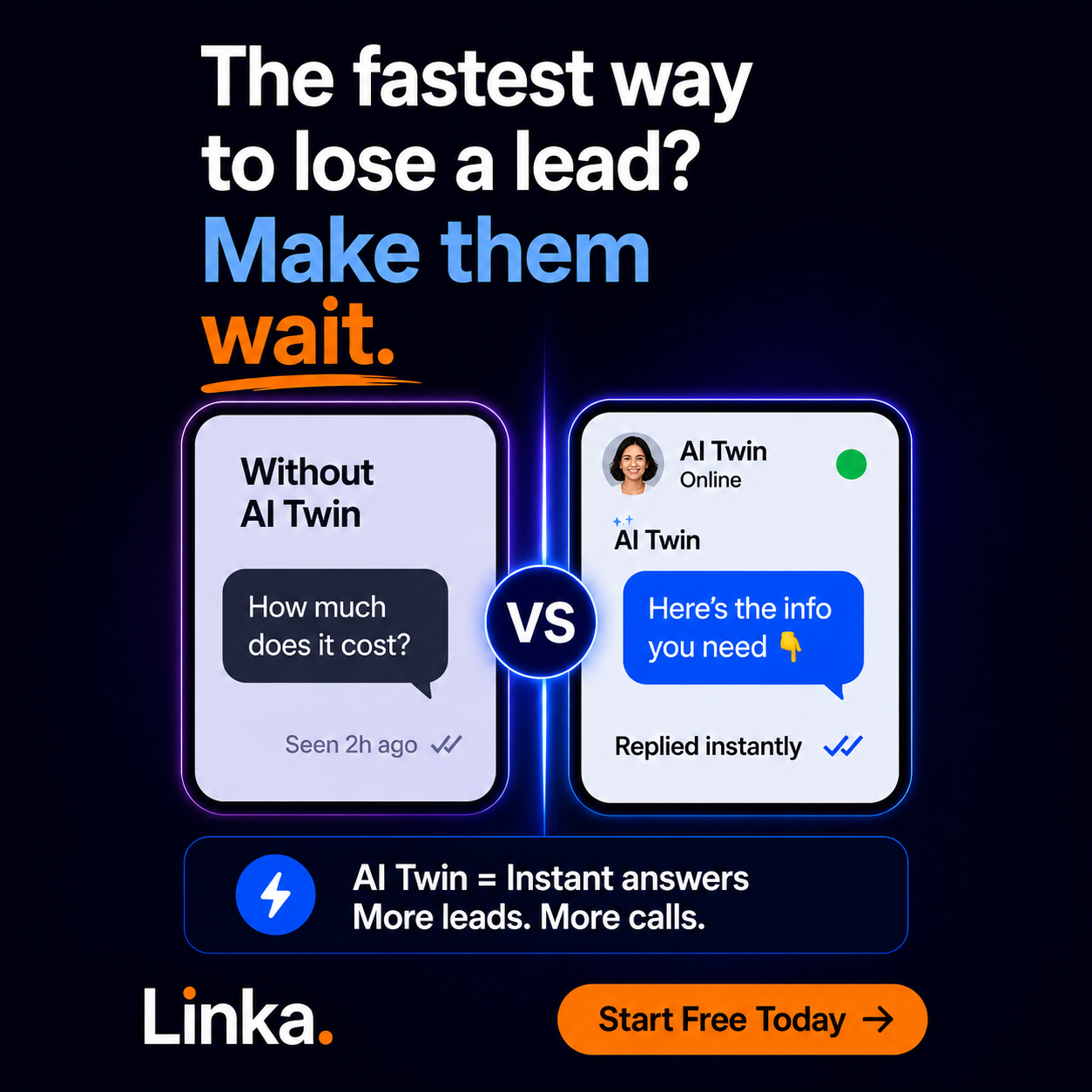
Most small business websites work like a brochure. Someone visits, looks around, and leaves. If they had a question, they might fill out a contact form. More likely, they didn't bother because they didn't want to wait a day for a reply. That's a lead lost.
An AI agent changes this entirely. When someone lands on your site with a question, the agent is instantly there to answer it, recommend the right service, capture their contact information, and move them toward taking a next step. It doesn’t use a scripted decision tree, but an actual conversation that sounds like you and knows your business.
Linka is built exactly for this. You train it on your services, your FAQs, your pricing, and your offers, and it handles the first conversation with every visitor — day or night, whether you're with a client or asleep. Leads get captured during the conversation, synced to your CRM, and ready for your follow-up.
Building Your Minimum Viable Lead Generation System
Here's the simplest possible version of a lead generation system that works — stripped down to what actually matters:
- One traffic source: A single channel you show up in consistently. It could be Google Business Profile, LinkedIn, Instagram, or a monthly email to your existing contacts. Just one, done well.
- One capture mechanism: Something on your website or in your content that converts interest into a lead. An AI agent that engages visitors in real time is the highest-converting option. A well-placed lead magnet with an email opt-in is the simplest.
- One follow-up sequence: A short series of emails that deliver value, share evidence you can help, and make it easy to take the next step. Automated so it runs without you touching it.
That's it. You don't need 12 channels, a CRM with 47 integrations, or a complex funnel. You need one path that works and the discipline to keep feeding it. Once leads are coming in consistently through that one path, *then* you add a second channel. Not before.
Find Out How to Generate Leads for Your Small Business with AI
If you’re ready to learn how to generate leads for your small business, stop reading about lead generation and start doing one thing. Pick your one primary channel and commit to it for 90 days. Set up something on your website that captures leads when people visit, even if it's just an AI agent that answers questions and collects contact details. Learn how it works by watching a free Linka demo.
The setup takes an afternoon. The upside is a sales channel that works while you sleep. Get started →

.webp)