.webp)
.webp)

You've got a website. You're posting on social media. Maybe you've even dabbled in ads. But the clients aren't coming in the way you expected, and you're starting to wonder if "building an online presence" is just something people say to sell you courses. Knowing how to get clients online requires a different approach.
It's about removing the gaps between when someone discovers you and when they actually hire you. That journey has maybe five or six steps, and most service businesses are unknowingly dropping people at one of them.
That’s why you need a practical system that actually helps you generate revenue — not a hack or a trend. A more straightforward process involving an AI sales agent determines what happens when people find you, how you keep the conversation going, and how you close.
How Do People Actually Hire Service Providers Online?
Before you optimize anything, it helps to understand what your potential client is doing before they ever contact you.
Most people hiring a service provider (e.g., a consultant, a designer, a coach, a lawyer, or a photographer) go through the same quiet process. They search for something (a problem or a solution), they evaluate a few options, they try to answer their own questions before committing to a conversation, and then they take action when they feel confident enough.
That last part is important. They take action when they feel “confident enough.” It’s not when they're most interested; they might be most interested at 9pm on a Wednesday while you're asleep. They act when their confidence catches up to their interest.
So there are really three questions your online presence needs to answer before someone will reach out:
- Is this person credible and legitimate?
- Can they solve *my specific* problem, not just problems in general?
- What do I do next, and is it low-risk enough to try?
If your website, social profiles, or content can't answer all three clearly and quickly, you're losing clients to someone whose presence answers those questions better — not someone who's actually better at the work.
How to Get Clients Online Without Treating Your Website Like a Business Card
Most service business websites are passive. They describe what the business does. They list some credentials. They have a contact form buried at the bottom. Then they just sit there. That's a business card, not a sales tool.
A website that actually brings in clients speaks directly to the person reading it, addresses their specific situation, and gives them a clear, easy way to take the next step. The difference in how those two types of websites perform isn't subtle — it's dramatic.
What to Look for on Your Site
Here are a few things worth auditing on your own site:
- Your headline: If the first line someone reads is your company name or tagline, that's already a problem. The headline should immediately tell a visitor who you help and what you help them achieve. "I help B2B SaaS companies increase trial-to-paid conversion" is infinitely more compelling than "Marketing Consulting Services."
- Your social proof: Testimonials, case studies, and results aren't decorative; they're doing active work. A visitor who's on the fence will look for evidence that you've helped people like them before. Specific outcomes beat vague praise every time. "We reduced our client onboarding time by 60%" beats "Sarah was amazing to work with!"
- Your call to action: How many options are you giving people? If the answer is more than one, that's a problem. Too many choices lead to no choice. One clear, low-commitment next step (e.g., a discovery call, a free audit, or a short application) converts far better than a menu of options.
After you’ve established these, there's the biggest gap of all: what happens when someone has a question that your website doesn't answer?
Linka lets you deploy an AI agent on your website that actually has the conversation a potential client needs before they're ready to book. It's trained on your services, your FAQs, your offers, and your content. When someone asks "Which of your packages includes ongoing support?" they get a real, accurate, and instant answer instantly.
How to Get Clients Online by Choosing One Channel
This is where most service businesses make a critical mistake. They try to be everywhere. They're posting on Instagram, updating LinkedIn, sending newsletters, writing blogs, making TikToks, running Google ads. Yet, none of it is getting traction because none of it is getting enough consistent effort to build momentum.
The truth is that almost every successful service business has one primary channel that drives the majority of their new clients. They got really good at that one thing before adding anything else. Here's how to pick yours.
SEO and Content Marketing
This works best if you're patient, you enjoy writing, and your ideal clients use Google to research their problems. It takes months to build momentum, but once it's working, it brings in inbound leads consistently without you pushing it. One well-ranked article answering a question your ideal client searches for is worth more than a year of scattered social posts.
LinkedIn is the most direct channel for B2B services. If your clients are business owners, executives, or professionals, this is where they already are. You don't need a massive following either. You just need a profile that clearly positions your offer, a posting cadence that keeps you visible, and the willingness to start conversations directly with people who fit your ideal client profile.
Instagram is the platform of choice for coaches, creative services, wellness professionals, and anyone whose work involves personal transformation. The key is moving people from passive consumer (someone who watches your content) to active conversation (someone in your DMs), because that's where trust turns into transactions.
Referrals
These are worth mentioning again here, and they’re technically a "channel" too, and for many service businesses, especially when starting out, it's the most effective one available. A referred client arrives with built-in trust and often converts without any of the friction of cold marketing.
Turn Engagement Into Actual Conversations
With almost every service business, people are engaging with your content, but that engagement isn't translating into leads or conversations.When someone has a 10-minute conversation with your AI agent before getting on a call with you, they arrive already informed. They're not asking basic questions; they're ready to move forward.
The reason is usually that there's no bridge. A like on a post is passive. A comment is slightly less passive. A conversation is where deals actually happen. But most businesses have no mechanism to move someone from one to the other.
Here’s how to get clients online by creating that bridge:
- On Instagram, your content captions and Stories can actively invite DMs. It’s not in a pushy way, but just giving people an obvious nudge. "If you're not sure which approach is right for your situation, DM me and I'll point you in the right direction" is disarmingly simple and consistently works.
- On LinkedIn, connecting requests followed by a genuine, non-salesy message to people who engage with your posts is one of the most effective forms of outbound that doesn't feel like outbound.
- On your website, adding a live engagement layer closes the gap entirely.
Capture Leads Before They Disappear
The average website converts less than 3% of its visitors into any kind of action. Which means even if your content is good, your positioning is clear, and your traffic is growing, you're still losing the vast majority of your potential leads.
Some of that is just the nature of buying timelines. People aren't always ready when they first find you. But a lot of it is lost opportunity that can be recovered simply by capturing contact information when interest is at its highest.
Lead capture doesn't have to mean a pop-up form that nobody fills in. The most effective lead capture happens naturally inside a conversation. Someone asks your AI agent a question, gets a helpful answer, and the agent follows up with something like "Want me to send you a summary of the pricing options?" They say yes, enter their email, and now you have a warm lead with context. You know what they were asking about, what they're interested in, and where they are in their decision process.
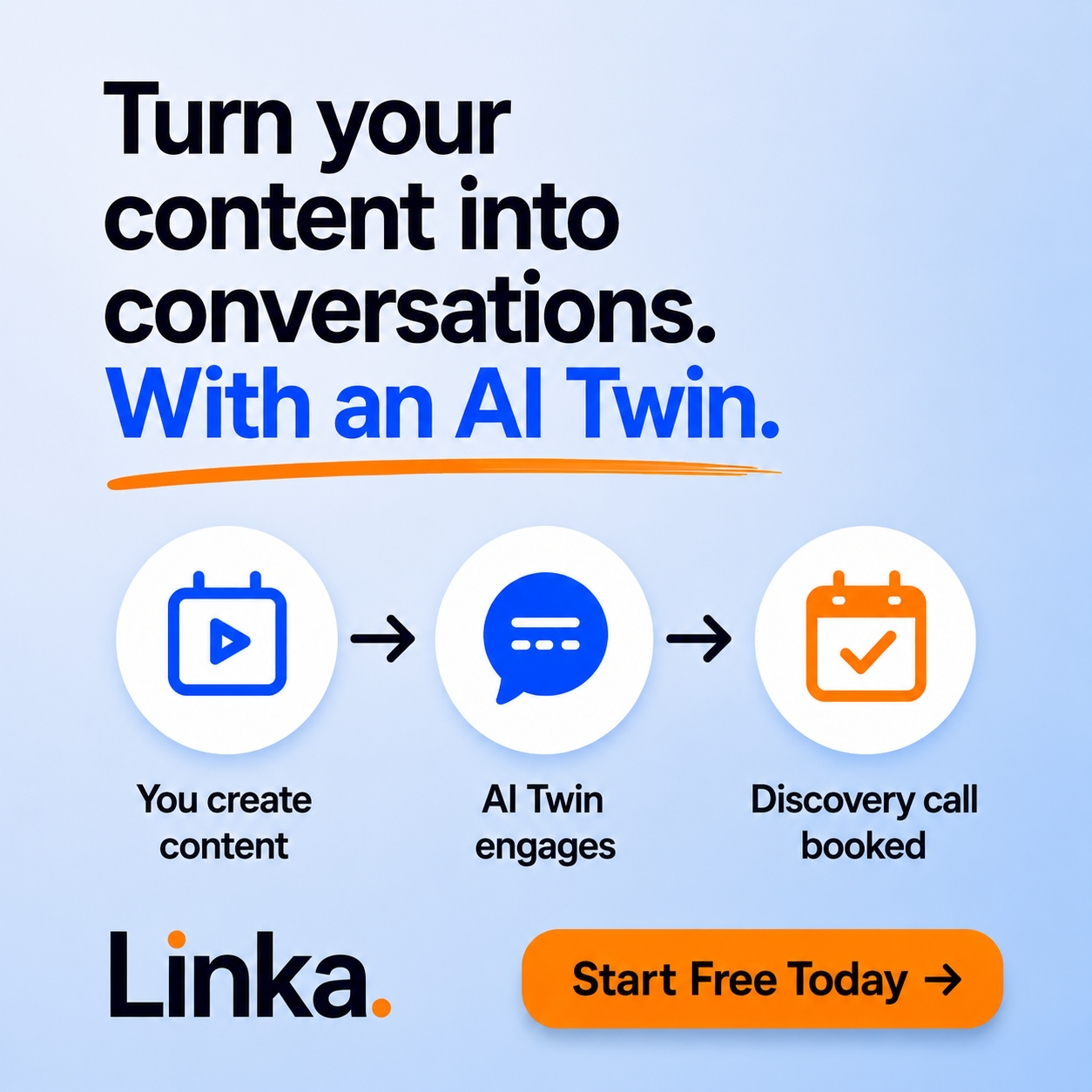
Linka captures this kind of data during every conversation and can sync it directly to your CRM through Zapier. So instead of chasing leads, you wake up to a list of people who engaged with your site overnight, along with exactly what they asked about.
Build a Follow-Up Process (Most Businesses Stop Too Early)
Most buyers need multiple touchpoints before they're ready to hire. Five, six, seven interactions, and sometimes more for higher-ticket services. Yet most service businesses follow up once or twice and then assume the person isn't interested.
The people who didn't reply to your follow-up email aren't necessarily not interested. They're busy. They got distracted. They're still deciding. Life happened.
A simple follow-up sequence that runs automatically keeps you present without requiring you to manually track every lead. The key is that the follow-up adds value rather than just pressuring for a decision. Each message should give the person a reason to open it, not just remind them that you exist.
Here’s a simple formula to follow:
- Day 1: Thank them for the conversation, share one useful resource related to what they asked about
- Day 3: Send a short case study or testimonial from a similar client
- Day 7: Check in briefly with something like "Just wanted to make sure you got what you needed"
- Day 14: A gentle nudge if you have a time-sensitive offer or limited availability
The Full System, Simplified
If you take everything above and strip it to its most essential form, here's the system:
- Attract: One well-chosen channel (SEO, LinkedIn, Instagram, or referrals) brings the right people into your world consistently.
- Engage: An AI agent on your website and in your social channels handles the conversation immediately, answers questions, and captures contact details — even while you're not available.
- Convert: A single, clear next step (one booking link, one application form) removes friction and makes it easy to take action.
- Follow up: An automated sequence keeps you present with people who weren't ready immediately, so you capture leads on a longer timeline without manual effort.
None of this requires a big team, a big budget, or a complicated tech stack. It requires clarity on who you're trying to reach, consistency in showing up for them, and a system that handles the repetitive work so you can focus on the actual client work you're good at.
Learn How to Get Clients Online with Linka
The coaches and consultants who grow online fastest aren't necessarily the best at marketing. They're the ones who've closed the most gaps between interest and action, and they've built the systems to do it without being in every conversation personally. To find out how to get clients online with AI, explore a free Linka demo.
If you're tired of leaving money in your DMs and on your website, Linka was built for exactly this. Try it free →

.webp)