.webp)
.webp)
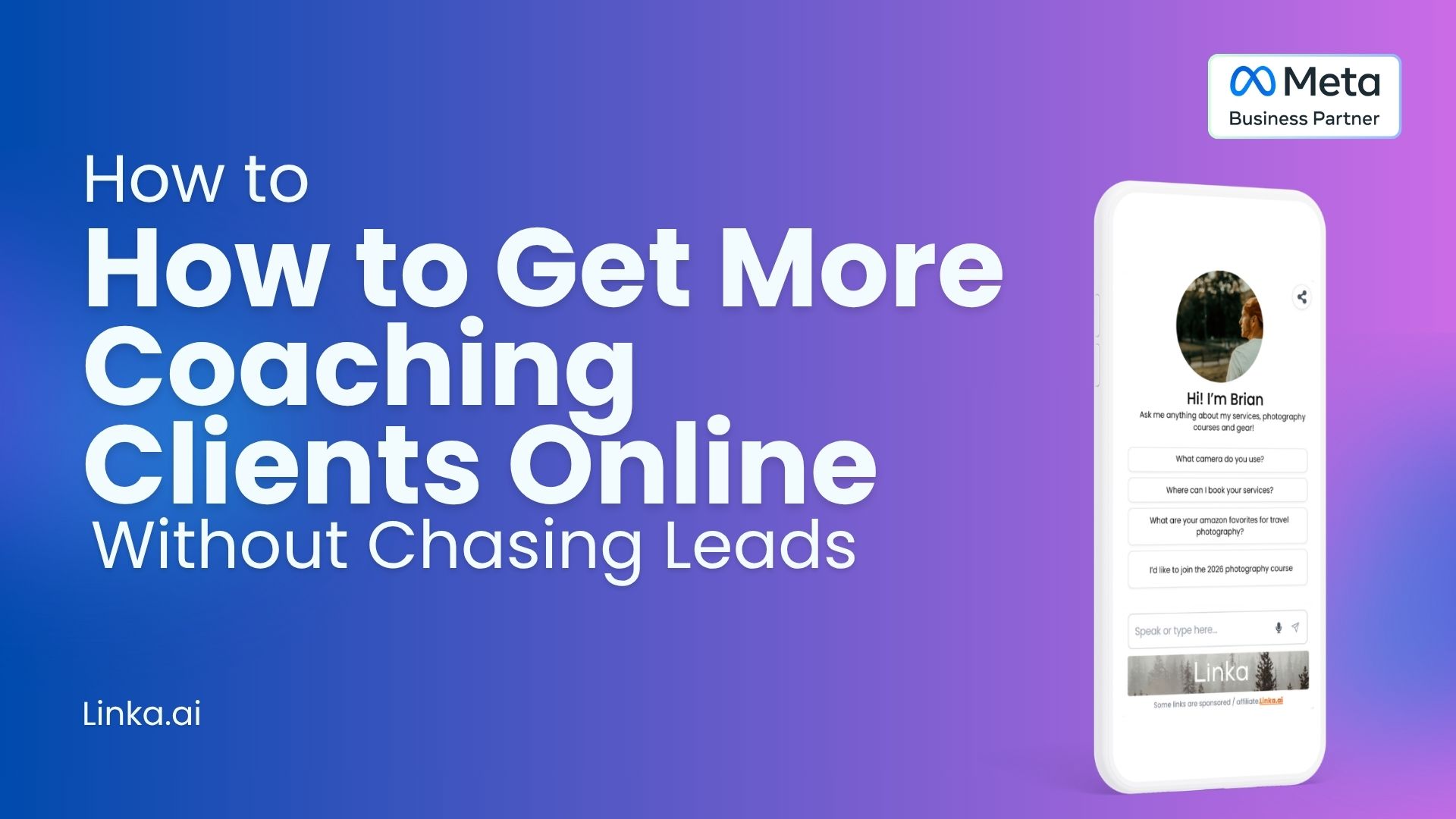
There's a specific kind of exhaustion that settles in for coaches around month six of running their business. The cold outreach is going out. The DM conversations are happening. The content is posting. Yet, at the end of each week, the number of new clients doesn't reflect the amount of effort that went into finding them. This is where knowing how to get more coaching clients online becomes key to your success.
Most coaches who feel stuck in the chase were taught that visibility plus persistence equals clients. That formula isn't wrong, but it's incomplete. Getting coaching clients online in a way that doesn't require constant manual effort means understanding the difference between activity that creates momentum and activity that just keeps you busy. The two can look nearly identical from the outside.
The coaches who've built sustainable online client pipelines aren't doing more. In many cases, they've stopped doing specific things entirely, such as cold messaging strangers, following up with people who never asked to hear from them, or trying to be present on every platform at once. In their place, they've built systems that attract the right people, engage them intelligently, and help them build a revenue-generating coaching business.
Why the Chase Model Breaks Down
The mechanics of outbound client acquisition are simple enough: reach enough people and some percentage will become clients. The problem is that the math doesn't hold up sustainably for most coaches. The behavior that keeps the math working (e.g., high-volume outreach, constant follow-up, relentless content) produces a kind of pressure that's difficult to maintain indefinitely without burning out.
There's a subtler issue underneath that. When outbound is the primary strategy, the business only grows when the coach is actively pushing. The moment they step back, whether for a vacation, an illness, or simply a hard week, the pipeline stalls. That's not a business with any real independence. It's a job with a different name.
Getting coaching clients online through inbound channels solves this at the root. When the right people are finding you rather than the other way around, the pipeline develops regardless of how active you were last week.
How to Get More Clients Online Using an Automated Funnel
The word "funnel" tends to conjure images of complicated automations and elaborate email sequences. In practice, the path from stranger to paying client is simpler to understand, even if it takes time to build well.
Someone encounters your content because it answered a question they were already asking. They feel understood enough to look further. They visit your profile or your site and are given a clear, frictionless next step. Something or someone is there to meet them in that moment. By the time they book a call, they already trust you, because the experience of finding you and exploring your work built that trust before any real conversation happened.
The piece most coaches leave out is what happens between "someone showed up" and "someone booked." That gap is where leads disappear, not because the interest wasn't there, but because nothing was there to keep it moving. A thoughtful online funnel for getting coaching clients designs that middle stretch with as much care as the content that drove the traffic in the first place.
A working online coaching funnel includes these connected elements:
- A Discovery Layer: Content on search, social, and video platforms that answers the questions your ideal client is already asking before they're ready to hire anyone.
- A Trust Layer: Case studies, testimonials, and methodology content that builds credibility after someone finds you and wants to understand whether you're the right fit.
- A Conversion Layer: An AI sales agent, live chat tool, or intelligent bio link that engages visitors in real time, answers their questions, and guides them toward booking a call.
- A Nurturing Layer: An email sequence or community touchpoint that maintains the relationship with people who are interested but not yet ready to commit.
- A Feedback Layer: Analytics and conversation data that shows you which parts of the system are working and where people are dropping off before they convert.
Most coaches have the first two. The ones who get the most coaching clients online consistently have all five.
The Channels That Actually Convert for Coaches Online
SEO and Long-Form Content
Search is one of the highest-intent channels available to any coach, because the people arriving through it were already looking for something. A prospective client who Googles "how do I know if I need a business coach" is much closer to a buying decision than someone who happened across a post in their feed.
Long-form content targeting buyer-intent questions builds compounding traffic over time. A well-written post that ranks for a specific phrase can send qualified visitors for years after publication. For coaches learning how to get coaching clients online without constant outreach, content designed around search intent is often the highest-leverage investment they can make in their business.
Social Content With a Conversion Path Built In
Social platforms are discovery channels more than intent channels, which means the content strategy has to account for that gap. Posts that educate, demonstrate methodology, or share transformation stories build the familiarity that eventually translates into inquiries. The variable most coaches underestimate is what happens after that interest forms.
For example, when a coach shares a carousel on Instagram that generates strong engagement, the question isn't how to respond to each comment manually. The question is what system is in place to capture that interest and move it forward. A comment trigger that opens an automated DM conversation, or a bio link that launches a live AI-powered exchange, changes the outcome of that post from "good engagement" to "actual leads in the pipeline."
Your Website as an Active Conversion Engine
Most coaching websites are built to impress rather than convert. They have clean design, a well-written bio, and a contact form visitors encounter after scrolling past content they didn't come looking for. What they rarely have is something that actively engages the person who's there right now, at 9pm, curious and willing to have a conversation.
This is where Linka makes a meaningful difference for coaches and service professionals who understand how to get coaching clients online. Rather than leaving visitors to click around on their own, Linka deploys an AI sales agent trained in the coach's voice that greets each visitor, answers their actual questions, explains which offer fits their situation, and moves them toward booking when they're ready. For coaches building an inbound pipeline, this is the difference between traffic that arrives and traffic that converts.
How Do You Turn Online Traffic Into Actual Client Bookings?
The biggest conversion factor most coaches overlook isn't copy quality or posting frequency. It's response time. A lead who asks a question and waits twenty-four hours for a reply has usually made a decision in the meantime, and it often isn't in your favor.
Real-time engagement, whether through an AI sales agent, a live chat tool, or an automated DM flow, solves this by eliminating the wait entirely. When someone asks "how does this work" at 11pm, something should be ready to answer. Not because the coach has to be available around the clock, but because the system can be. That immediacy is one of the clearest practical advantages coaches who know how to get coaching clients online have built into their pipelines.
The other lever worth paying attention to is where social proof appears in that journey. Not a testimonials page buried in the navigation, but specific client results placed on the pages and inside the conversations where buying decisions are actually forming. A prospect who sees a transformation story at the exact moment they're evaluating whether to book a call is in a very different position than one who has to go looking for that proof themselves.
What a Realistic Inbound Timeline Looks Like
One of the reasons coaches revert to outbound is that inbound takes longer to produce visible results. A cold DM can generate a booked call this week. A blog post that ranks takes months to build consistent traffic.
The difference is what each approach produces over time, and what it costs in energy to sustain. Here's how getting coaching clients online through an inbound system typically develops:
- Months one through two: Foundations are set. Content is publishing, the website conversion layer is live, and the inbound channels are beginning to index and accumulate. Leading indicators to track here are content output and site traffic trends, not client inquiries.
- Months three and four: Early traction starts to emerge. The AI sales agent is having conversations with site visitors. Social content is building pattern recognition in your audience. Occasional inbound inquiries arrive without direct prompting.
- Month five and beyond: Traffic compounds. The system starts working without requiring daily input. Inbound leads tend to arrive more qualified because they've already done their research before reaching out, which typically means higher close rates and shorter sales conversations.
Start Getting More Coaching Clients Online With Linka
With Linka, you can plug in an AI agent that can live on your website, inside your Instagram and LinkedIn DMs, in your link‑in‑bio, and even alongside your newsletter content. You set it up once by connecting your pages, offers, and voice notes, and it keeps answering, recommending, and capturing leads across every channel where your audience already shows up.
Because the platform was built specifically for coaches, consultants, and other service providers, you also get clear reporting on impressions, clicks, bookings, and conversions, so you can finally see which parts of your online presence are actually responsible for new clients. That’s what turns getting more coaching clients online from a vague goal into something you can measure, optimize, and rely on month after month.
How to Get More Coaching Clients Online with Linka
When your online presence is built to attract and engage rather than chase, your coaching business starts to grow on its own terms rather than in direct proportion to how hard you pushed this week.
Explore the Linka demo and find out how to get coaching clients online with an AI sales agent that turn website visits and social followers into qualified conversations, in your voice, around the clock.
If you're tired of leaving money in your DMs and on your website, Linka was built for exactly this. Try it free →
.webp)