.webp)
.webp)
Every marketing team has sat in a meeting where someone pulls up a slide full of big numbers, and vanity metrics have a way of making those meetings feel better than they should. The reach is in the hundreds of thousands, impressions are climbing every week, and the chart only ever seems to point up and to the right, yet the moment someone asks how many of those impressions turned into a sale, the room goes quiet.
Many of us have sat through versions of that meeting too. The numbers being celebrated measure exposure dressed up as success rather than anything connected to revenue, and they've been shaping marketing budgets for far longer than they've deserved to. But how much do those metrics really matter when compared to actual conversions?
What Actually Counts as a Vanity Metric?
A vanity metric is any number that looks good on paper without telling you much about whether your business is actually growing. Impressions, follower counts, and total reach all fall into this category, not because they're meaningless, but because they measure how many people might have seen something rather than how many people did anything about it.
Exposure and outcome get treated as interchangeable in a lot of reporting, and they aren't. Someone can scroll past a post without registering it at all, and that scroll still counts as an impression. A follower who muted an account eight months ago still sits in the follower total. Neither number reflects a single moment of real interest, which is why campaigns built on them so often feel successful right up until the revenue report arrives.
How Impressions Became Everyone's Favorite Number
Impressions earned their spot at the top of the dashboard the same way clicks did, by being easy to count and easy to explain. A number that only goes up is a comfortable thing to present in a meeting, and impressions almost always go up as long as a campaign keeps running.
For years that logic held together, because advertising was still borrowing its assumptions from television and print, where reach was the best available signal of how many people might encounter a message. Digital platforms inherited that thinking before anyone had built better ways to measure what happened after someone saw a post.
Then the ground shifted underneath it. Feeds got crowded, attention fragmented across more apps, and buying conversations moved into private channels where impressions can't follow. TechCrunch reported that users and businesses now have around 600 million chats on Meta's platforms every day, which is a staggering amount of commercial intent flowing through a channel that never registers on an impressions dashboard.
There's an internal incentive at work too, and it's worth naming. Marketing teams get judged on the numbers they choose to report, so choosing numbers that reliably climb is a form of self-protection. Nobody ever got a hard question in a quarterly review because impressions went up, which means the metric persists partly because it keeps meetings comfortable rather than because it keeps businesses growing.
Why a Big Reach Doesn't Guarantee a Single Sale
A brand can post content that reaches tens of thousands of people and generate almost no business from it, while another brand reaches a fraction of that audience and sells out a product line. There’s no contradiction there. That's simply what happens when vanity metrics get separated from actual buyer interest, and it happens constantly.
Part of the problem is that big-reach numbers reward the wrong content. A post can rack up impressions because it's controversial, oddly timed, or boosted by an algorithm having a good day, without ever connecting with the audience a brand wants to sell to. Meanwhile a smaller, more focused post might reach far fewer people and still generate real conversation because it lands with exactly the right ones.
The signals worth trusting instead share a common trait, which is that each one costs the audience a little effort:
- Comments that ask questions, since someone asking about price, availability, or sizing is actively considering a purchase rather than reacting out of habit
- Keyword comments, where a person deliberately types a word under a post because they want information delivered to their inbox
- Direct message volume, which almost always tracks more closely with sales than any impression count ever will
- Saves and shares, because both actions signal that content is worth revisiting or worth showing to someone whose taste the sharer knows
- Repeat engagement, since a person who comments across multiple posts over time is showing sustained interest, not a one-time reflex
At the end of the day, effort is the honest currency of attention, and vanity metrics cost the audience nothing at all.
What This Looks Like When Real Money Is on the Line
Let’s use a home goods brand running two creator posts in the same week as an example. One features a trending sound and racks up eighty thousand impressions with almost no comments. The other is a quieter product demo where the creator invites viewers to comment the word COZY for a link, and it reaches twelve thousand people while generating three hundred keyword comments, each one triggering a DM that carries the person straight to the product page.
If that brand reports on impressions, the trending post wins in a landslide. If it reports on conversations and clicks that arrived with intent behind them, the second post isn't just better, it's the only one doing measurable work. The same pattern shows up when brands choose which creators to partner with in the first place.
The deeper reason vanity metrics persist is structural rather than stupid. Most ad platforms charge by impression or click, so their dashboards naturally celebrate impressions and clicks. When the billing model changes, the reporting follows, and that's precisely the change happening now.
How Linka Replaces Vanity Metrics With Numbers That Pay
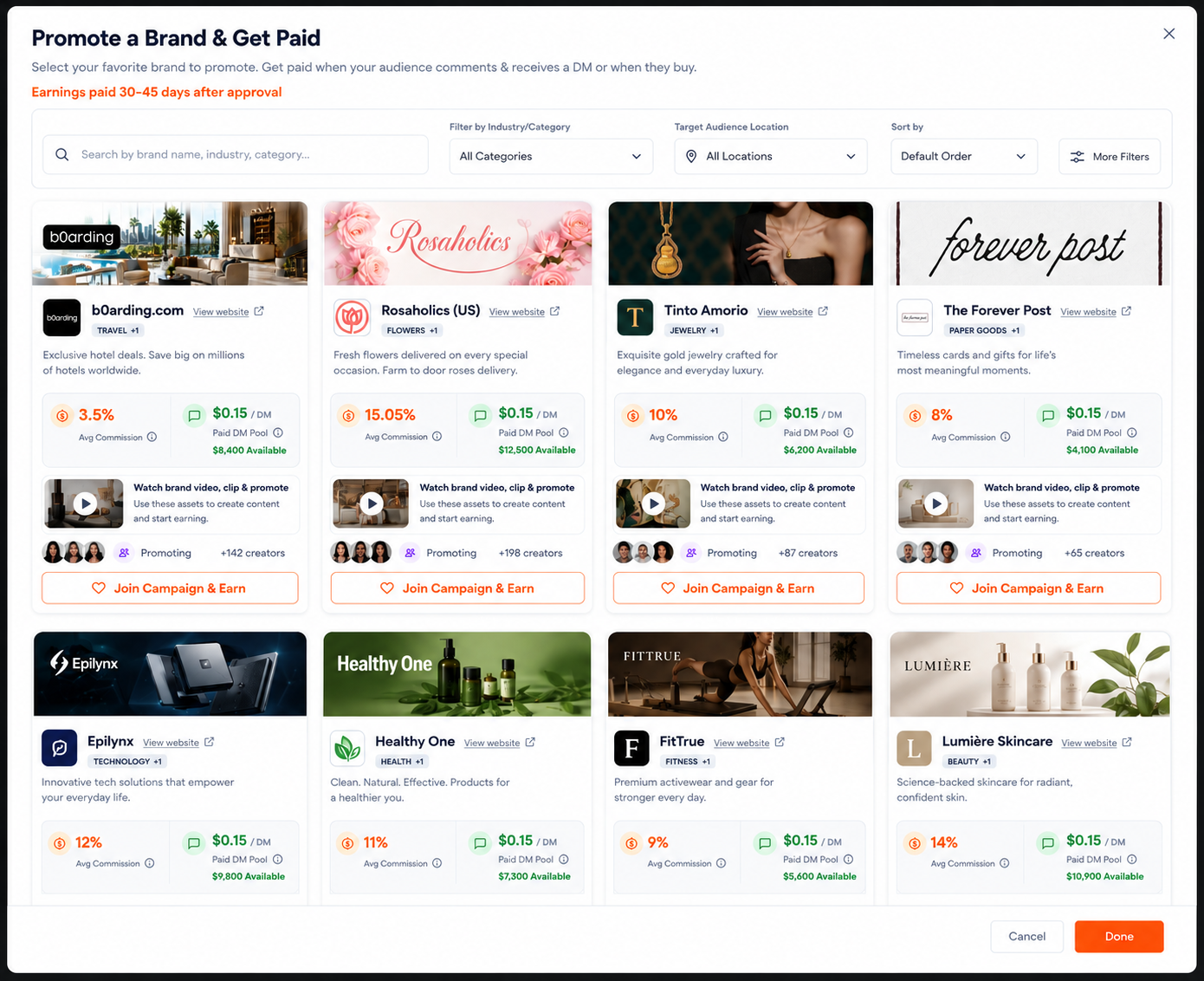
Linka runs performance-based DM campaigns across a network of thousands of creators, and the billing model matches the behavior that matters. Brands pay per DM conversation rather than per impression or per click, which means every dollar spent maps to a person who commented a keyword and asked to hear more.
The mechanics are simple to follow. Creators publish content featuring a brand's products, their audiences comment with campaign keywords, and those keywords trigger intent-based DMs that answer questions and drive clicks to the brand's site. Alongside those campaigns, each creator's personalized AI sales agent, which is a conversational assistant trained on the creator's own content and chosen brands, recommends partner offers inside everyday DM conversations and through the creator's Shop. Custom AI built this way is quietly rewriting how affiliate marketing operates, because recommendations now happen at conversation scale instead of one reply at a time.
What shows up in reporting changes accordingly:
- Conversation-Level Tracking: Every keyword comment and DM ties back to whether it produced a click, a lead, or a completed sale, so attribution follows the actual person.
- Content Performance Beyond Reach: Brands see which creators, posts, and offers generate real engagement rather than which ones simply reached the most scrollers.
- Network-Wide Visibility: A performance dashboard shows results across every creator promoting an offer, including the growing list of global brand names in Linka's catalog of more than 5,000 partners.
- Real-Time Signals: Because DMs fire the moment keywords appear, the data reflects what's happening now rather than a summary assembled days after a campaign ends.
Something subtle happens to creative strategy once this data starts flowing. When a team can see which questions audiences actually ask inside DM conversations, content planning stops being guesswork about what the algorithm might amplify and starts being a response to demonstrated curiosity. The comments become a research department, and the products people keep asking about become the obvious candidates for the next campaign.
How Brands of Every Kind Plug Into the Network
The same mechanics flex across very different situations, and the network behind them has grown into real scale, with more than 10,000 creators and publishers distributing offers from thousands of partner brands across beauty, wellness, travel, food, hospitality, fashion, and lifestyle.
Those partnerships have driven more than 120 million clicks and recommendations, along with over $58 million in gross merchandise value so far. Companies can start a brand-new affiliate program using Linka or link up an existing one, and most of the setup work happens automatically. Linka's AI reviews a brand's site, product catalog, pricing details, and FAQ pages to understand its offerings and tone before rolling them out across the network on its own, eliminating the need for manual outreach or partner briefings.
Once that's in place, matches occur right when interest is expressed. If someone poses a question beneath a creator's post or on a publisher's website, fitting products appear as a natural response, and every view, click, and sale is monitored throughout the entire process, giving brands visibility into which creators, placements, and deals are generating income. A modest monthly platform charge covers onboarding and distribution, while everything else comes from a portion of commissions the brand was already planning to pay, collected only when a sale actually happens.
Questions Brands Ask When They Make the Switch
Should We Stop Reporting Impressions Entirely?
No, and pretending exposure doesn't exist would swing too far the other way. Impressions still describe distribution, and distribution still matters as context. The change worth making is hierarchical rather than total, meaning conversations, clicks, and conversions lead the report while vanity metrics move to a supporting line where they can inform without misleading.
How Quickly Do Conversation Metrics Show Results?
Faster than most teams expect, because DMs fire the moment keywords appear rather than accumulating in a delayed attribution window. A brand running its first keyword campaign typically sees conversation and click data within days of a creator's post going live, which means the comparison against older metrics settles itself inside a single reporting cycle instead of a quarter.
Can This Data Be Gamed the Same Way Impressions Can?
Not the way impressions can. Impressions are trivial to inflate through bots, boosted placements, or an algorithm surfacing something for reasons that have nothing to do with audience interest, which is exactly why the number keeps climbing without ever proving anyone cares. A keyword comment requires a real person to type something specific under a post, and the DM it triggers goes to that same person's inbox, so there's no equivalent shortcut for manufacturing volume. The data can still be small if a campaign underperforms, but it can't be padded the way a reach number can.
Where Vanity Metrics Should Sit in Your 2026 Reporting
Vanity metrics aren't going away, and they still deserve a modest place in reporting as context for distribution, but they should never again sit at the top of the slide. The numbers worth building budgets around are the ones tied to expressed intent, which in practice means keyword comments, DM conversations, and the clicks and sales those conversations produce. How that intent gets priced is its own story.
Making the switch is less painful than most brands expect. A brand connects its catalog, sets its commission terms, and Linka's AI distributes offers across creators and publishers whose audiences already ask relevant questions, with no individual outreach to manage. The fastest way to feel the difference is to watch it happen. Linka can walk you through a real conversation from keyword comment to completed sale when you book a call with us.
The big numbers will still be there next quarter. The question is whether anything real is underneath them. Find out how to launch an affiliate program with Linka.

.webp)