.webp)
.webp)
A brand manager opens a media kit and the first number they see is a follower count, which tells you almost everything about what influencer marketing has been selling for a decade. The count is usually big, usually bolded, and usually the anchor for every rate in the negotiation that follows, yet nobody in that conversation tends to ask how many of those followers ever stop scrolling long enough to comment, ask a question, or send a message about the product being promoted.
That gap shapes a lot of budgets, and we watch its consequences play out constantly at Linka. Brands keep paying for the size of an audience without much visibility into whether that audience responds, which means a lot of spend goes toward reach that was never going to convert into anything at all.
What Does Influencer Marketing Actually Sell Today?
Most influencer marketing deals still price on audience size. A creator with a hundred thousand followers commands one rate, a creator with a million commands a much higher one, and the negotiation starts and ends with that single number.
The stakes of getting this wrong keep climbing, because the money involved keeps climbing. Goldman Sachs Research expects the creator economy to approach $480 billion by 2027, with brand deals accounting for roughly 70 percent of how creators earn. When that much budget prices itself on a single vanity number, small measurement errors become expensive habits.
Follower count is a vanity number, because it measures potential exposure rather than actual interest. A large following tells a brand how many people could theoretically see a post, but nothing about how many will pause, read, and act. Two creators with identical counts can produce wildly different results depending on how alive their audiences actually are.
Why Follower Count Keeps Winning the Negotiation
Follower count survives as the default metric because it's simple, one number that fits in a spreadsheet, compares cleanly across creators, and requires no digging through comment sections to evaluate. Engagement takes more work to judge properly, since its value depends on the quality of interactions rather than their volume.
Agencies and platforms reinforced the habit for years, because pricing influencer marketing on reach made their own inventory easier to package and sell. When the whole supply chain quotes rates per thousand followers, an individual brand manager pushing back on the convention looks difficult rather than diligent, so the convention holds even after most people in the room privately stop believing in it.
That instinct made sense before engagement data was accessible. Today the signals are sitting in plain sight, including:
- Engagement on sponsored content specifically, since a creator's paid posts often perform very differently from their personal ones, and that difference is the number a brand is actually buying
- Comment quality over comment count, because a handful of specific questions about ingredients or sizing signals more intent than a pile of emoji reactions
- DM volume around product content, which is often the single strongest predictor of buying behavior a creator can show
- Response habits, since a creator who answers their audience builds the trust that converts, while one who posts and vanishes leaves interest to cool
- Evidence from past campaigns, because tracked results from previous partnerships say more than any reach projection
None of this means abandoning large creators, only asking what a budget is actually buying before committing it.
What Gets Missed When Reach Is the Only Filter?
Consider two creators up for the same skincare campaign. The first has four hundred thousand followers and posts polished content that earns strong view counts and few comments. The second has thirty thousand followers, posts casual videos, and regularly draws dozens of specific questions about ingredients plus a steady trickle of DMs asking where to buy.
Booked on follower count, the first creator wins easily and costs several times more. Measured on conversations, the second creator is generating exactly the behavior a skincare brand needs, people asking real questions because they're seriously weighing a purchase. This mismatch repeats across influencer marketing constantly, and it's the same vanity metrics trap, just wearing a different outfit.
The deeper insight is that the mistake isn't picking the wrong creators so much as buying the wrong product. Brands have been purchasing exposure when what they wanted was conversation, and no amount of better creator selection fixes a deal structure that pays for the former and hopes for the latter. To put it into perspective, reach is only the brochure; the conversation is the actual store.
What Does Performance-Based Influencer Marketing Look Like?
Performance-based influencer marketing is the model Linka was designed around, and it inverts the traditional deal. Instead of paying a flat fee for a post and hoping, brands run performance-based DM campaigns across our network of thousands of creators. Creators publish content featuring the brand, audiences comment with campaign keywords, and each keyword triggers an intent-based DM that answers the question and drives a click to the brand's site. Brands pay for those DM conversations rather than for impressions or clicks, so every dollar maps to a person who deliberately raised a hand.
The structure solves the follower-count problem automatically, because payment follows response instead of audience size. A creator with thirty thousand engaged followers who generates three hundred keyword comments simply earns more than a creator with half a million passive ones who generates twelve, and the brand's spend lands wherever conversion actually happens. Compensation finally aligns with contribution on the creator side.
For example, when a supplement brand joins the network and a fitness creator adds it to a campaign, the creator might post a morning routine video inviting viewers to comment FUEL for the details. Two hundred comments later, two hundred intent-based DMs have been delivered, each carrying the brand's link, and the brand has paid for two hundred real conversations instead of a hundred thousand theoretical views.
There's a second distribution channel stacked on top. Every creator in the network can build a personalized AI sales agent, a conversational assistant trained on their own content that chats with followers around the clock and recommends the brands the creator has chosen to promote, both in DMs and through their Shop. When a follower asks that agent for a moisturizer recommendation at midnight, a partner brand gets suggested inside a trusted conversation no ad placement could reach. That compounding is a big part of how custom AI is transforming affiliate marketing from static links into living recommendations.
How a Brand Plugs Into the Network
Partnering with Linka is deliberately lighter than running a traditional influencer marketing program, because the network does the matching that agencies used to bill for.
Here's how it works:
- Connect Your Catalog: A brand links its products and offers once, and Linka's AI learns what it sells and who tends to ask about it.
- Set Performance Terms: The brand defines its commission structure, then pays for DM conversations and results rather than reach.
- Distribute Automatically: Offers surface across thousands of creators through keyword DM campaigns, AI agent recommendations, and creator Shops, alongside a catalog of more than 5,000 partner brands that keeps adding global names.
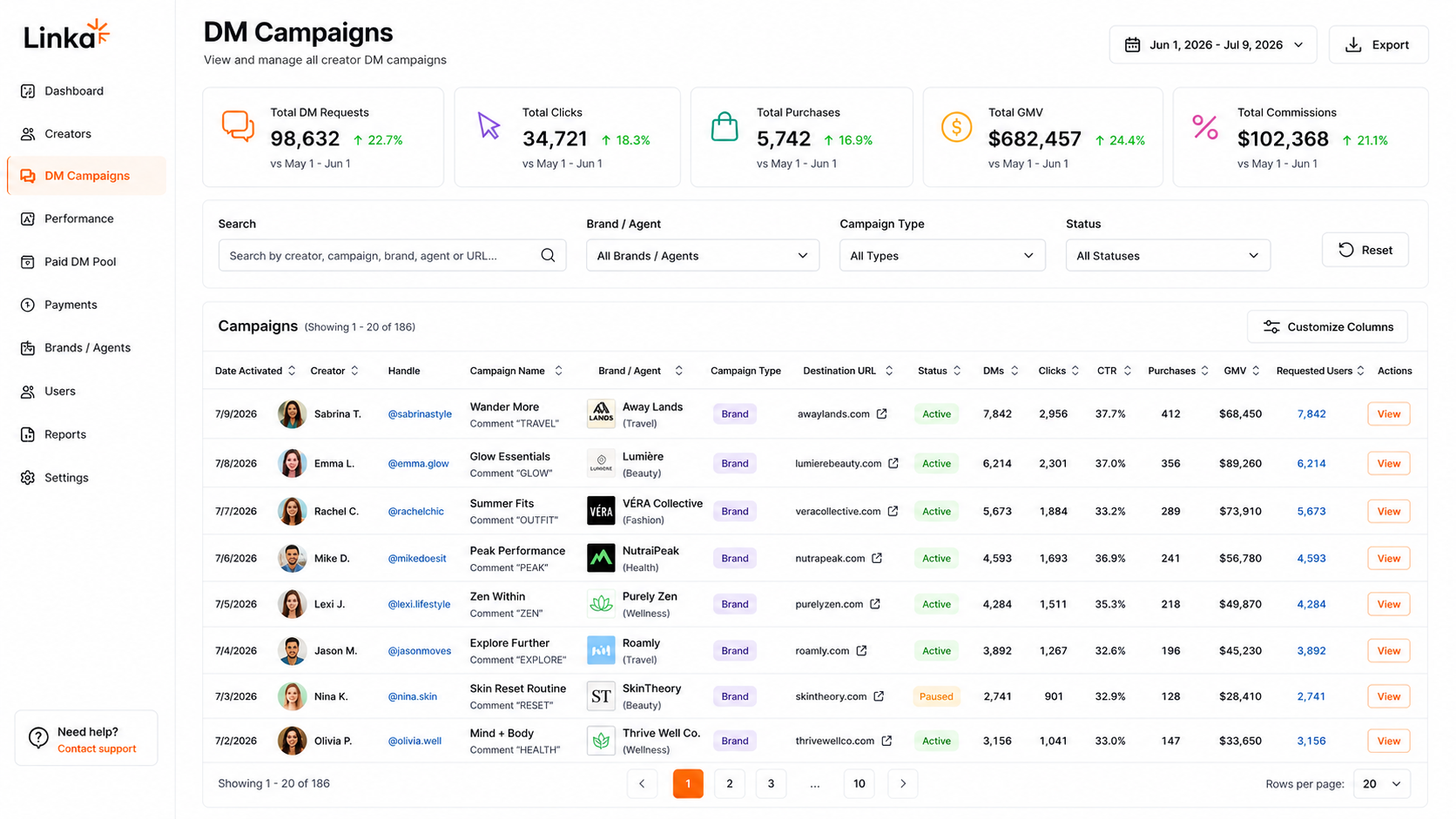
- Track Everything: A performance dashboard shows which creators, posts, and conversations produced clicks, leads, and sales, at the level of individual exchanges.
Because campaign posts keep triggering DMs for as long as they stay live, distribution compounds over time instead of expiring when a contract does. A brand's catalog keeps getting recommended month after month by agents and evergreen posts, which turns influencer spend from a series of one-time purchases into an appreciating asset.
What Changes Inside Your Brand’s Affiliate Program Once Reach Stops Being the Metric
Switching what you pay for doesn't stay contained to the media plan. It tends to ripple into how an affiliate program works once follower count stops anchoring the conversation. For example:
- Briefs get more specific, since asking a creator to "post about the product" gives way to asking them to invite a keyword comment around a particular offer, which forces clearer thinking about what the campaign is actually trying to prompt
- Contract negotiations shift focus, moving away from a flat rate tied to audience size and toward commission terms tied to conversations and outcomes, which changes what a brand and a creator are even negotiating over
- Reporting decks look different, since a slide built around impressions and reach gets replaced by one built around conversation volume, click-through, and the sales those conversations produced
- Renewal decisions get easier, because a brand deciding whether to work with a creator again has actual performance history to look at instead of a gut feeling about how the content felt
- Cross-team credibility improves, since a marketing team that can show a finance or leadership team a direct line from spend to tracked revenue stops having to defend soft metrics in budget reviews
What Brands Ask Before Moving Their Budgets Here
Do Big-Name Creators Still Have a Place in This Model?
Absolutely, and some of the strongest performers in the network are large accounts with audiences that actually respond. The difference is that their size no longer earns them a premium by itself. A big creator whose followers comment and convert gets paid handsomely because the conversations are there, not because the count is, and that's a standard the best large creators welcome.
How Long Until a Campaign Produces Data Worth Trusting?
Days rather than months, in most cases. Keyword DMs fire the moment comments appear, so conversation volume, click-through behavior, and early conversions show up almost immediately after a creator's post goes live. By the end of a first campaign cycle, a brand usually knows which creators, offers, and content angles deserve more budget, with individual conversations as the evidence.
Do We Still Get to Choose Which Creators We Work With?
Yes, though most brands end up relying less on hand-picking than they expected to once the data starts coming in. A brand can still favor specific creators or niches, but Linka's AI also surfaces the network of thousands of creators whose audiences are already asking about relevant products, which widens the pool well beyond whoever a brand manager happens to already follow. Once conversations start flowing, the creators worth keeping tend to identify themselves through performance rather than through a pitch deck.
Buying the Right Thing From Influencer Marketing
Getting influencer marketing right ultimately comes down to paying for what you actually wanted all along, which was never the audience but the conversations inside it. Follower count will keep being the first number on every media kit, and it can stay there as context. The deal itself should be priced on keyword comments, DM conversations, and the tracked clicks and sales they produce, because those are the behaviors that put revenue on the table.
If you want proof before commitment, book a call with Linka and see how a real conversation moves from comment to conversion.
The media kits won't change overnight. Your results can. Find out how to get started with your affiliate program today!
.webp)