.webp)
.webp)

Every measurement system in performance marketing records that something happened. An impression served. A link clicked. An order placed. Not one of them records why, and the why is the only part that can be acted on. AI shopping has made that omission expensive.
According to Awin's two-year review of its own platform data, shopping journeys involving AI tools take roughly 60% longer to complete on average, peaking at 89% longer in the UK against a 31% baseline in the US, and involve between 81% and 128% more steps before purchase depending on the market.
This means that AI is adding consideration to the shopper’s journey rather than removing it. Every additional step is a question a shopper asked somewhere, and in nearly every case that question goes unrecorded by the infrastructure being paid to measure the journey.
The Category That Didn’t Exist Two Years Ago
Two years ago Awin's index of its most innovative partners had no category for AI shopping at all. The 2026 edition gives it a dedicated label, alongside partners using natural language understanding and product matching to reshape how people find and buy things.
The share of activity remains modest. Awin reports that AI traffic appears in only 0.2% to 0.5% of affiliate sales across the UK, US, Germany and France, defined as a journey including a click-through from an AI tool that ends in a sale.
The behavior inside that fraction is where the interesting part lives. Cart values rise by up to a 119% depending on the market, with the lowest reading, 27% in Germany, still substantial. High value, high consideration, low volume. Anyone who has watched a category form will recognize the shape of that, and the temptation to dismiss it on volume alone is exactly the mistake that gets made each time.
Why AI Shopping Made the Journey Longer
The intuition was that AI would compress shopping. Ask a machine, get an answer, buy the thing.
What happened instead is that every answer generated another question. A shopper asks a general-purpose model about a product and receives a competent, wide-ranging response that sends them to three brands they had not considered, a comparison they had not thought to run, and a specification they now feel obliged to understand. They leave better informed and further from a decision.
This pattern isn’t confined to AI. impact.com's first-half analysis of 2,319 North American brands recorded clicks up 6% against conversion down 12% across the whole market. People are researching harder everywhere. AI has simply poured fuel on a fire that was already burning.
Trust has not moved with the technology, which is the second useful finding. Research from impact.com with Cube and Dentsu, surveying 2,400 consumers across six Southeast Asian markets, found 40% of respondents said generative AI had not changed how much they rely on creators for product recommendations. Forty-nine percent of affiliate purchases in that regional study were driven by trust and validation, against 28% driven by utility and convenience.
These figures describe Southeast Asia specifically and shouldn’t be read as global, but the direction is consistent with what the affiliate data shows elsewhere. More research, same reliance on people.
What a Click Records and a Conversation Does Not
Consider what a brand actually learns from a standard funnel.
An impression proves exposure. A click proves interest of an unspecified kind. A purchase proves the outcome. Line them up and you have a record of three moments and no explanation connecting them. When conversion falls twelve percent, the system can confirm the fall and offer nothing about its cause.
Now consider what sits between those events. A shopper wondering whether a formulation suits their skin. Whether the item ships before a birthday. Whether the larger size earns its price. Those sentences are the most commercially useful language a customer produces, and in almost every program they are spoken into a comment section and lost within a day.
The strategic version is simpler. A conversation layer generates a class of data that impression-based and click-based infrastructure can’t produce, no matter how well instrumented it becomes, because the information was never encoded in a click to begin with.
Where General Purpose AI and an AI Shop Diverge
The comparison that matters isn’t between AI and no AI. It’s between an AI that sends people outward and one that answers where the question was asked.
A general-purpose assistant is optimized to be useful about everything. It has no catalog, no relationship with the person asking, no stake in a particular outcome, and no memory of the creator whose recommendation started the whole thing. It’s a research tool, and research tools extend journeys by design.
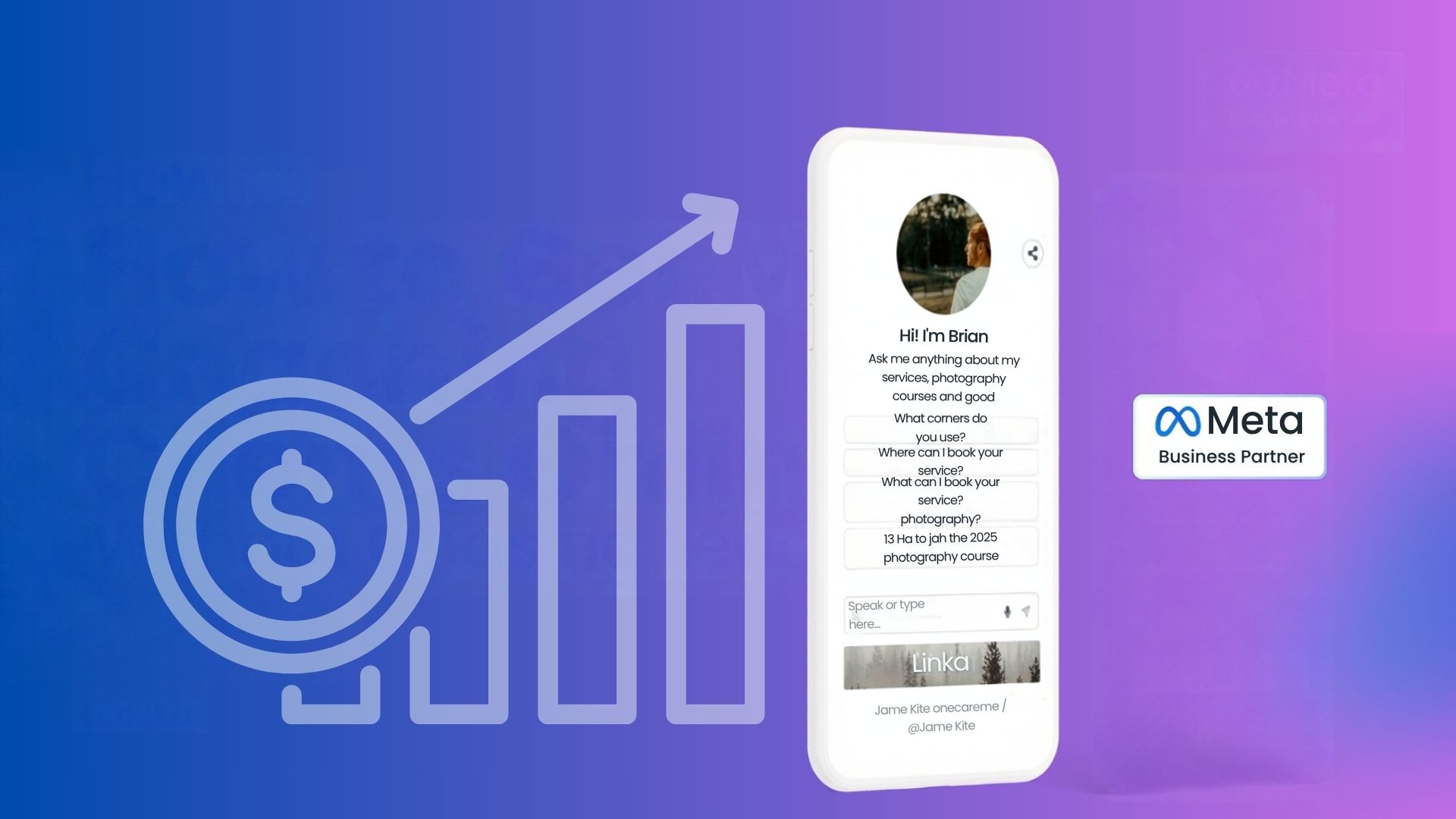
Linka approaches the same moment differently. Its primary engine is Meta DM automation, where a comment on a creator's Instagram or Facebook post triggers a tracked direct message carrying the product, the offer, and the next step. The qualified DM becomes a recorded, compensable event, so creators earn on the conversation alongside affiliate commissions. Shoppers then move into a dynamic discount conversion page built for that campaign, which holds the product, the creator's recommendation, the offer and the purchase path in one tracked place.
The second engine is the AI Shop, an always-on multi-brand experience living in a creator's AI shopping agent, answering product questions against approved brand information rather than the open web.
Every one of those exchanges produces something a click can’t:
- Which product drew the question.
- Which objection recurred.
- Which creator's audience asks about fit and which asks about price.
Linka reports more than 18,000 creators and publishers, over 12,500 partner brands and offers, and more than 64,000 DMs sent across the network, which is the raw material from which that behavioral record is built. That’s the creator commerce category that affiliate networks, creator platforms, and DM tools all missed.
Does the Data Actually Compound?
Anyone who has sat through a decade of pitch meetings has heard the proprietary data moat argument, and has watched most of them fail to hold. Honesty about the conditions matters more than enthusiasm about the thesis.
Conversation data work best when several things stay true at once:
- The record has to be structured rather than archival, since a warehouse of message transcripts is a cost rather than an asset
- Volume has to arrive across many creators, products and verticals, because a deep record of one category teaches you about one category
- The data has to feed decisions that can be measured, such as creator matching, offer design, product selection and budget allocation, or its accuracy is never tested
- Qualification standards have to be strict enough that the record describes genuine intent rather than automated noise
Those are real conditions and none of them are automatic. What can be said with confidence is narrower and still meaningful. The behavioral map showing how particular creators, products, offers and questions turn attention into purchases is not obtainable from click logs, and the industry's dominant infrastructure is built almost entirely on click logs.
The Signal Worth Watching
A tenth of a percent of affiliate sales carry AI traffic today, and those journeys carry carts worth up to twice as much and take considerably longer to close. Consideration is expanding rather than contracting, and the expansion is happening in a part of the funnel that current infrastructure was never designed to observe.
Whoever records what buyers ask before they buy ends up holding the only explanation of why anything converted. For a category still deciding on its language and standards, that record is the position worth taking early.
Interested in how AI shopping conversations become measurable performance data? Book a call with Linka to see how the AI shopping layer, qualified DMs and affiliate attribution connect inside one system.

.webp)