.webp)
.webp)
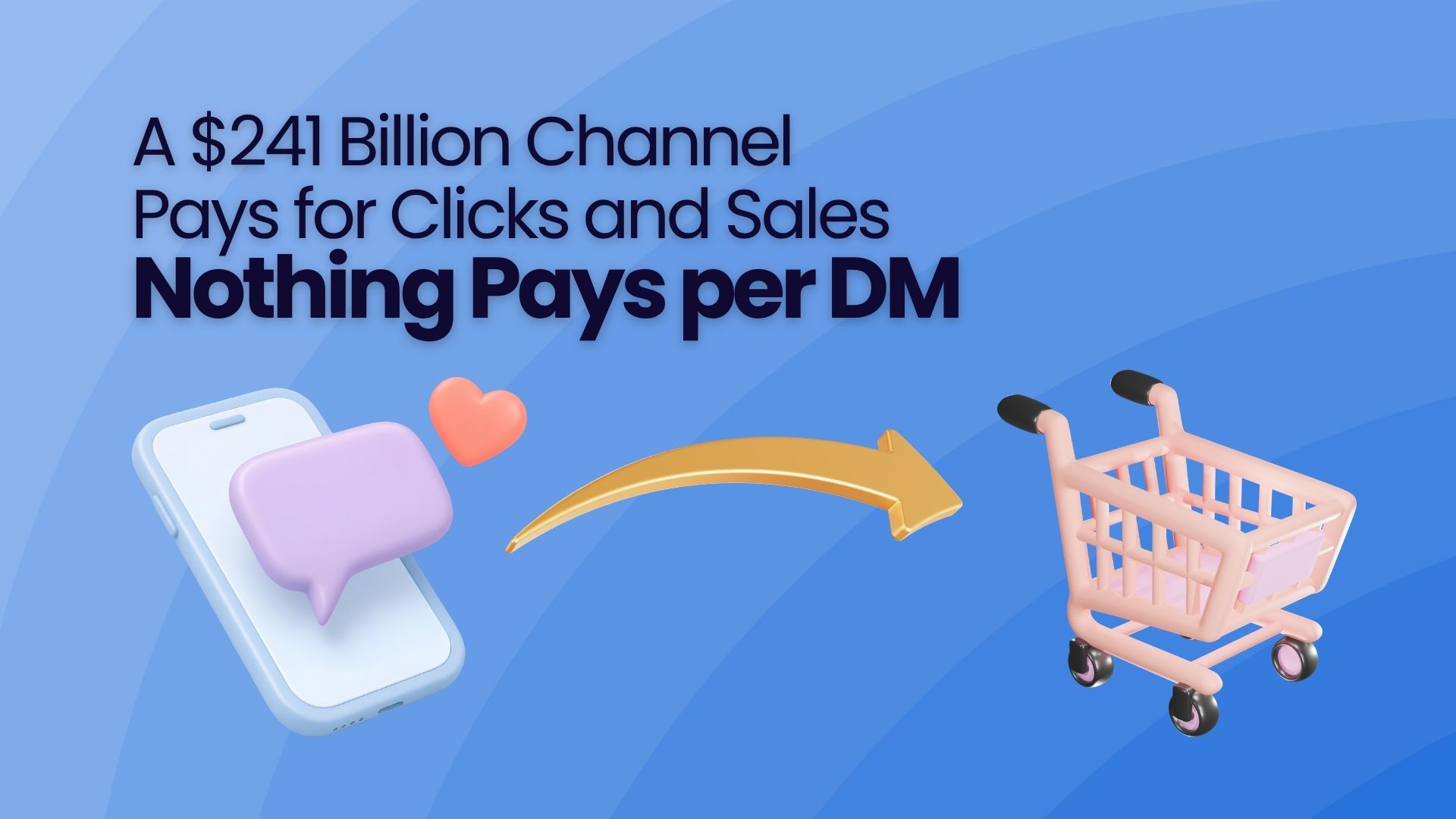
Affiliate marketing has spent thirty years getting very good at paying for two events. Somebody clicks. Somebody buys. Every rail, contract, and dashboard in the channel is built around those two moments.
The channel is now large enough that the gap between them is worth noticing. EMARKETER puts affiliate at roughly $241 billion in influenced US ecommerce sales for 2026, with cash back, loyalty, and rewards platforms claiming the largest share of affiliate ad spend at 35 percent and content publishers at 16 percent, while creators remain the fastest-growing publisher category.
Cost per DM prices a third event that sits between the click and the sale, the moment a buyer asks a question and someone answers it. No incumbent rail pays for that moment, which means the most decisive step in a modern purchase is the one nobody has priced. In a market this size, an unpriced high-intent event is not a permanent condition.
Where the Money Sits Versus Where the Persuading Happens
Look at the spend distribution and the strangeness becomes visible.
The largest share of affiliate budget goes to cash back, loyalty, and rewards platforms. Those partners are excellent at what they do, and what they do is arrive at the end. A shopper who has already chosen the product passes through a cash back layer on the way to checkout and the commission attaches there.
Content publishers, whose reviews and comparisons do a meaningful share of the actual convincing, take a considerably smaller share. Creators, who supply the trust that starts the journey, are growing fastest from the smallest base.
So the money concentrates where attribution is cleanest rather than where persuasion is strongest. That isn't a conspiracy, it's a measurement artifact. Last-click reporting credits whoever stands closest to the register, and budgets follow reported credit. We traced the same distortion at the campaign level in why the smallest line in a brand's affiliate partner mix is also the most efficient, and the market-level version is the same shape at a much larger scale.
Markets tolerate this kind of misallocation for a long time. They don't tolerate it forever, and what usually ends it is somebody finding a way to measure the thing that couldn't previously be measured.
What Cost per DM Actually Prices
Every pricing model in advertising history has named a unit of value and then built infrastructure around it. These include:
- Cost per mille priced exposure
- Cost per click priced interest
- Cost per acquisition priced the outcome
Each one arrived when the previous unit stopped explaining enough about what was happening, and each one moved money toward whoever could deliver the newly measurable thing.
Cost per DM prices a qualified conversation, rather than a view, visit, or imcomplete sale. The moment a buyer identifies themselves as a buyer and states what's standing between them and a purchase. That moment has always existed. It has simply never been a billable event, because until conversations became structured and trackable there was no way to count it.
The reason it matters strategically is that the conversation carries information the other three units don't. A click tells you somebody was interested in something. A DM tells you what they were worried about, in their own words, before they decided. Volume is one thing; that informational asymmetry is another.
Why the Timing Is Interesting Now
Three conditions have converged, and none of them existed together five years ago:
- Consideration is expanding. Shoppers research longer and across more surfaces than they used to, which stretches the unmeasured middle of the funnel rather than compressing it. More journey, less of it visible.
- Messaging became infrastructure. Meta DM automation made it possible to trigger, route, and track a conversation at campaign scale rather than one inbox at a time. The conversation stopped being a manual craft and became something a system can count.
- Creators became the fastest-growing publisher category while remaining a small share of spend. Fast growth from a low base with a measurement problem attached is a fairly reliable signature of a repricing that hasn't happened yet.
The category forming in that convergence isn't a feature of affiliate marketing or of creator tooling. It sits between them, which is why neither incumbent built it, a point worth reading alongside the argument that four adjacent industries each solved one layer and none priced the conversation.
What Has to Be True for Cost per DM to Matter?
Being honest about the conditions is more useful than asserting the thesis, particularly for anyone who has heard a lot of these pitches. For Cost per DM to matter, these criteria must be met:
- Qualification has to be strict. A DM that isn't a genuine buying conversation is noise, and a model that pays for noise gets gamed into worthlessness quickly. The standard for what counts as qualified is the whole integrity of the unit.
- It has to sit alongside commissions rather than replace them. Brands are not going to stop paying for sales, nor should they. Cost per DM works as an additional rewardable event in an existing program, which is also what makes adoption plausible without a rebuild.
- The data has to feed decisions that get tested. Conversation records that inform creator matching, offer design, and product selection prove their value or don't. Records that sit in a warehouse are a cost.
- Attribution has to survive the whole path. From comment through conversation through conversion page through checkout, or the model inherits the same credit problem it exists to solve.
Linka is building against those conditions. Meta DM automation as the primary engine, dynamic discount conversion pages carrying the tracked path to purchase, and AI Shopping Agents holding approved products between campaigns, with connections into AWIN, Rakuten, CJ, Impact, and Shopify so brands can layer the model onto programs they already run. Across the network Linka reports more than 18,000 creators and publishers, 12,500 partner brands and offers, and over 64,000 DMs sent.
The Event Nobody Priced
A $241 billion channel with its budget concentrated in the least differentiated partner types, at the exact moment the most persuasive partners became measurable, is a setup rather than a steady state.
Cost per DM isn't a new pricing gimmick layered onto affiliate marketing. It's the same move the channel has made three times already, naming a unit of value that the previous generation of infrastructure couldn't see.
The conversation was always where the deciding happened. It's only now that anyone can count it.
Interested in how cost per DM prices the conversation between the click and the sale? Book a call with Linka to see how qualified DMs, affiliate attribution, and AI Shops connect inside one system.
.webp)