.webp)
.webp)
If you run a small business and haven't tried ChatGPT yet, you're in a shrinking minority. Most owners have opened it at some point, often to draft an email, brainstorm a campaign idea, or answer a question that would've taken twenty minutes to research manually. What's far less common is someone who has figured out how to use ChatGPT for small business in a way that actually moves revenue.
The gap between experimenting with AI and operationalizing it is where most small businesses stall. ChatGPT for small business use is genuinely useful. It's one of the most capable general-purpose tools available, and it saves real time on the right tasks. The question is which tasks those are, and where a different kind of AI tool does something ChatGPT was never designed to do.
This distinction matters more than most people realize. Using the right AI for the right job is the difference between AI that saves you an hour of drafting and the one that captures leads, answers questions, and closes sales while you're in client sessions, sleeping, or anywhere else entirely.
What Can ChatGPT Actually Do for a Small Business?
ChatGPT is a general-purpose AI language model, which means it's excellent at tasks that involve generating, analyzing, or transforming text. For small business owners, those tasks show up constantly, and the time savings are real.
The areas where ChatGPT for small business use consistently delivers value include:
- Email and Proposal Drafting: First drafts of client emails, follow-up sequences, service proposals, and onboarding documents that you can then edit into your voice. What used to take forty-five minutes can become a ten-minute review.
- Content Ideation and Outlining: Blog post topics, social caption angles, video script frameworks, and FAQ page structures. ChatGPT generates options quickly, which makes it useful as a brainstorming collaborator even when you don't use its output directly.
- Research and Summarization: Competitive landscape overviews, industry terminology explanations, and quick synthesis of information you'd otherwise spend time reading through manually. It's not a substitute for authoritative sources, but it's a useful starting point.
- Customer Communication Templates: Pre-written responses to common client questions, refund policy language, intake form questions, and onboarding checklists. Once these templates are built, they free up significant repetitive work.
- Rewriting and Editing: Cleaning up rough notes into polished copy, adjusting tone from casual to formal or vice versa, and condensing long explanations into clear summaries.
These are legitimate, high-value applications. The issue isn't that ChatGPT doesn't work for small businesses. It's that many owners try to apply it to use cases it wasn't built for and then wonder why the results feel hollow or disconnected.
Why ChatGPT for Small Business Isn't Designed for Live Conversations
Here's the part that trips most small business owners up. ChatGPT is a tool you actively operate, not a system you deploy to run independently. Every session starts fresh. It doesn't know your offers, your pricing, your past conversations, or your brand voice unless you re-explain those things at the start of each new interaction. The moment you close the tab, it stops working.
This makes ChatGPT genuinely unsuitable for the thing most small businesses need most: an always-on presence that engages potential customers the instant they show up, answers their specific questions about your specific business, and moves them toward a purchase or a booking without requiring you to be there.
Think about what actually happens when a prospective client lands on a service business website at 8pm on a Thursday. They have questions:
- Is this the right service for my situation?
- How does pricing work?
- What happens after I book?
If there's nothing there to answer those questions in real time, most of them leave. Not because they weren't interested, but because the moment passed before it was met.
ChatGPT for small business owners runs into the same wall by adding a generic chatbot or hoping visitors find the contact form. The tool isn't trained on your business, and it isn't running unless you're running it.
What an AI Sales Agent Does Differently
A purpose-built AI sales agent solves a fundamentally different problem than ChatGPT does. Where ChatGPT is a general tool you prompt manually, an AI sales agent is trained on your specific content, deployed on your specific channels, and runs conversations autonomously in your voice, around the clock.
The distinction shows up immediately in how each one handles a live customer interaction. For example, imagine a brand photographer whose potential client visits their website at 9pm and types into the chat: "I'm launching a product in six weeks. Do you have availability and what's included in a commercial shoot?"
A general AI tool with no knowledge of that photographer's calendar, packages, or pricing can't answer that question usefully. An AI sales agent trained on the photographer's service descriptions, pricing tiers, and booking process can respond immediately with accurate information, handle the follow-up questions, and route the prospect to a booking link before they've had a chance to close the tab.
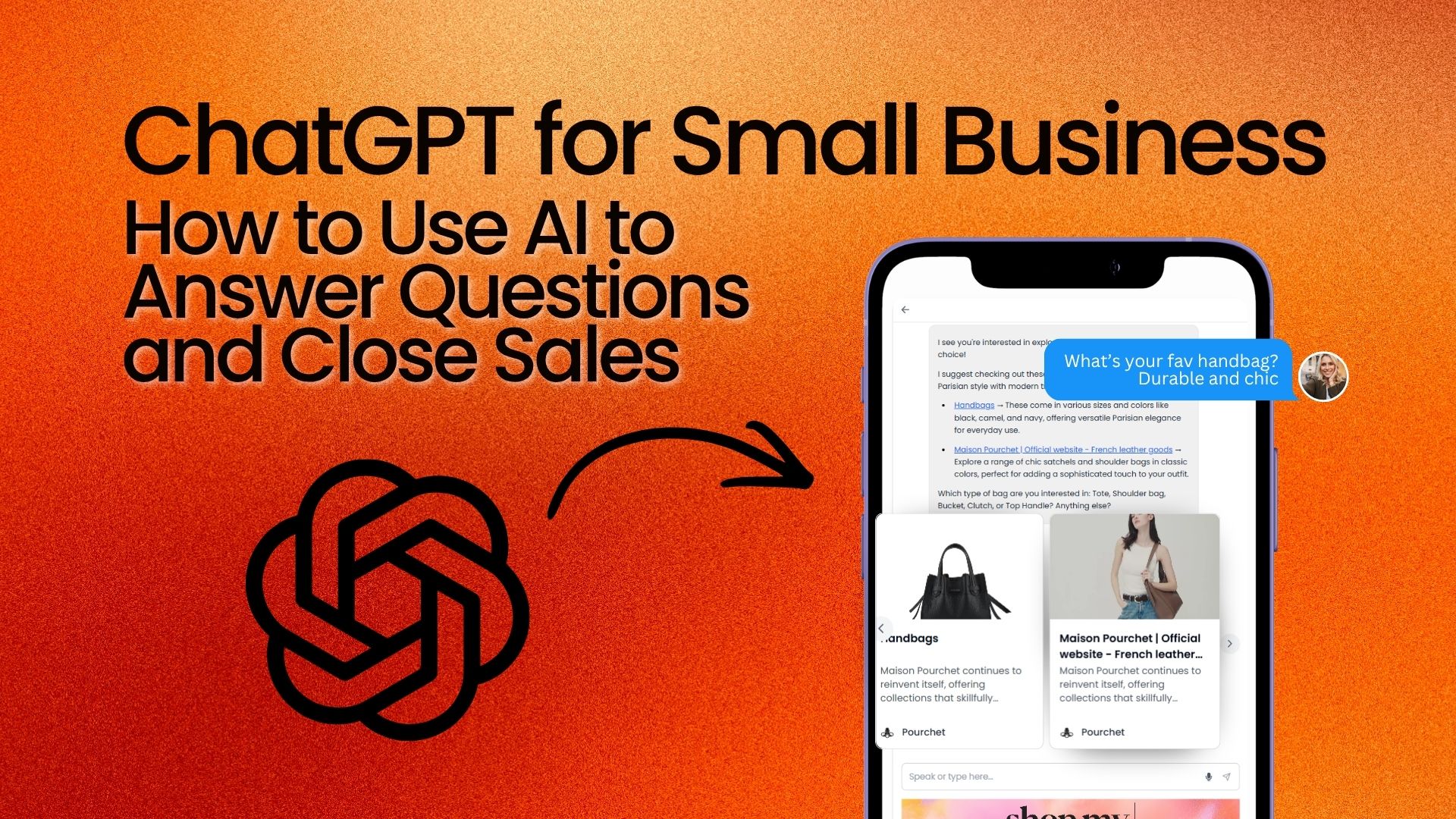
Our platform, Linka, is built specifically for this kind of deployment. For service professionals, coaches, creators, and small business owners who want an AI agent trained in their voice and loaded with their offer knowledge, Linka makes that agent available across your website, your bio link, and your social channels, so it's working on your behalf wherever potential clients show up.
As those conversations happen, your agent naturally captures emails and key details, then sends you real‑time lead alerts so you know exactly who raised their hand and what they’re interested in.
How Do You Build an AI Agent for Your Small Business?
The process of moving from "I use ChatGPT for drafting" to "I have an AI agent handling customer conversations and lead qualification" is shorter than most small business owners expect. It doesn't require technical skills or developer involvement. It requires a clear sense of what you want the agent to do and the content to train it on.
The transition from using ChatGPT for small business drafting tasks to having an AI agent running customer conversations is less a technical upgrade than a strategic one. It's a decision to stop requiring your presence in every interaction and start building something that works when you're not there.
Define the Agent's Primary Job
Answering product or service questions, qualifying leads, handling booking requests, or guiding visitors to the right offer. Starting with one clear function produces better results than trying to handle everything at once.
You can treat this like writing a job description for a new hire. Is the agent primarily there to make sure no pre‑sale question goes unanswered, to filter out unqualified leads, or to take people from “I’m interested” to “I’ve paid”?
Feed It Your Business Knowledge
Your website content, service descriptions, pricing information, FAQ answers, and any written material that represents your business accurately. Linka scans this content automatically so no manual programming is required. It also lets you point the agent at specific URLs or scan your whole site.
Set the Voice and Boundaries
Written instructions that tell the agent your tone, what topics are in scope, what questions to escalate to you, and how to handle situations it doesn't have enough information to address.
This is where you make sure it sounds like you and not “a bot.” You can specify how formal or casual it should be, what phrases to use or avoid, and how you want it to respond when someone asks about discounts, custom work, or anything sensitive.
Deploy It Where Your Audience Is
Your website homepage, service pages, bio link, and anywhere a potential client might arrive and have a question. Most platforms make this a copy-paste or single-link process with no code involved.
With Linka, that deployment can also include Instagram DMs and comments, where keyword triggers or replies to specific posts automatically open an AI‑powered conversation instead of leaving people waiting in your inbox.
Review the Conversations and Iterate
The questions your agent receives are a real-time signal of what your potential clients actually want to know. Reviewing those conversations regularly tells you what to add to the training, what objections need addressing, and where the conversion path can be improved.
Inside Linka, every interaction is stored with context, so you can scan transcripts, see which links get clicked, and identify patterns.
What's the Real Business Case for AI in Small Business Sales?
The value calculation for a deployed AI sales agent is simpler than it might seem. Consider how many potential clients visit your site in a typical month and leave without converting. Consider how many DM inquiries arrive after hours and receive a reply the next morning, by which point the prospect has often made a different decision. Then, consider how much time goes into answering the same ten questions over and over across emails, DMs, and calls.
An AI agent that handles all three of those scenarios doesn't replace the relationship you build with clients. It protects the opportunities that currently evaporate before that relationship ever gets a chance to start.
A Linka agent tracks the conversation. Every interaction is stored inside a built‑in CRM so you can see who engaged, which links they clicked, and which offers they asked about, all in one place. Instead of guessing which posts or traffic sources are driving revenue, you have a clear record of which conversations turned into bookings or sales.
Using ChatGPT for small business productivity is a solid starting point, and we'd encourage any owner to keep using it for the drafting and research tasks where it genuinely excels. But for the customer-facing side of the business, the tool that needs to be running isn't the one that requires your prompting to work. It's the one that's already there when the next prospective client shows up.
Start Putting AI to Work in Your Business With Linka
The small businesses gaining the most from AI right now aren't necessarily the ones using the most tools. They're the ones that have matched the right tool to each job, using general AI for internal productivity and purpose-built agents for customer engagement.
When you're ready to add the customer-facing layer to your AI setup, explore the Linka demo and see how our team builds AI sales agents for small business owners that answer questions, qualify leads, and guide buyers toward a decision, in your voice, at any hour.
If you're tired of leaving money in your DMs and on your website, Linka was built for exactly this. Try it free →
.webp)